
Why 7 Out of 10 Reservation Calls Don't Convert (And 6 Things Top Hotels Do Differently)
Your marketing worked. The phone rang. Here's what's happening between that ring and the lost booking — and a practical playbook to fix it.
Here's a story that plays out at hotel front desks hundreds of times a day.
A couple is planning a weekend getaway. They search Google for boutique hotels in their favorite destination. They click your paid ad — that costs you somewhere between $4 and $8. They browse your website, like what they see, and do something that should make every hotelier celebrate: they pick up the phone to book direct.
Your front desk agent answers. The guest asks about room options for their dates. The agent hesitates, clicks through a few screens, and says, "Let me check on that — can I put you on a brief hold?"
Twenty seconds of dead air pass. Then thirty. The guest, phone in one hand, opens Booking.com with the other. By the time the agent returns with a rate, the guest has already seen the OTA price, the free cancellation badge, and the one-tap booking button.
"Thanks, I'll think about it," the guest says.
They don't think about it. They book on the OTA that same evening.
Your property just paid twice for that guest. Once for the Google ad. And again — roughly 15 to 25 percent of the booking value — in OTA commission. For a three-night stay at $200 per night, that's around $108 in commission on a reservation that tried to come direct.
And the worst part? You'll never know it happened.
The Number Most Hotels Don't Want to Talk About
Industry data paints a consistent picture: the average hotel converts only 25 to 30 percent of reservation inquiry calls into confirmed bookings. That means for every 10 guests who call your property with genuine intent to book, roughly 7 end up somewhere else — usually an OTA, sometimes a competitor.
Let's make that real. Here's a formula you can run with your own numbers:
Your Annual Revenue Leak
payments on bookings that should have cost you zero.
And this doesn't even account for the upsell revenue that disappears when a guest books through an OTA instead of speaking with your reservation team — the spa package they would have said yes to, the suite upgrade they didn't know was available, the early check-in that would have added $40 to the folio.
The reservation desk is the least measured sales channel in most hotels. Front desk teams handle thousands of revenue conversations per month with virtually no analytics. You know your website's bounce rate down to the decimal. You know your ad campaign's cost per click. But the phone — the channel where your highest-intent guests are literally calling to give you money — operates as a black box.
The 5 Places Reservation Calls Break Down (And You'd Never Know Without Listening)
After analyzing thousands of hotel reservation calls, clear patterns emerge. These five failure modes are not about bad employees — they're about gaps in training, tools, and process that most properties don't even realize exist.
If you manage a reservation team, you'll probably recognize at least three of these.
1. The Hesitation Spiral
The guest asks, "What's the rate for a Deluxe King for next weekend?"
The agent goes silent. Keys click. Five seconds pass. Then ten. "Let me just pull that up for you..."
That silence is devastating. The guest interprets it as uncertainty — and uncertainty is the opposite of what drives a direct booking. They're already comparing you to an OTA that displays the price instantly.
What the data shows: Agents who quote the rate confidently within the first 60 seconds of the call convert at significantly higher rates — one benchmark puts it at 34% higher — than agents who hesitate or put the caller on hold to look it up.
2. The Missing Best Rate Guarantee
The guest says, "I saw it for $189 on Expedia."
The agent says, "Oh, okay."
That's it. No mention of the property's Best Rate Guarantee. No price match. No explanation of why booking direct is better. The guest has just told you exactly what it would take to win the booking, and the agent let the moment pass.
Most hotels have some form of direct booking benefit — whether it's a formal Best Rate Guarantee, a loyalty discount, or an exclusive perk. But if agents aren't trained to lead with it, it doesn't exist in the mind of the guest.
3. The Upsell That Never Happened
The guest books a standard room. The agent confirms the dates, reads back the rate, and wraps up the call. Done.
Except it shouldn't have been done. Nobody mentioned the suite upgrade that's $40 more per night. Nobody offered the spa package that runs on weekends. Nobody asked about early check-in or the dining credit for direct bookings.
What the data shows: Suite upgrades are mentioned on only about 23% of booking calls. But when they are offered, 41% of guests accept. That's not a small number. That's meaningful revenue being left on the table on every call where the offer simply isn't made.
4. The Phantom Follow-Up
The call ends with, "I'll send you a quote by email" or "Let me check availability and call you back."
Nobody calls back. Nobody sends the quote. The guest waits a few hours, assumes the hotel doesn't care, and books through an OTA.
This isn't negligence. It's a systems failure. Most properties have no mechanism to track a pending callback. The promise evaporates the moment the agent picks up the next call. There's no log, no reminder, no accountability. The guest who would have booked direct is gone by evening.
5. The After-Hours Void
A guest calls at 9:30 PM to book an anniversary trip. They get voicemail. They don't leave a message — almost nobody does. They open a booking app on their phone, find your property, and book with two taps.
You'll never know that call happened. There's no missed-call follow-up because there's no record of what the caller wanted. The revenue went to an OTA simply because no one was there to answer.
What the data shows: Properties that ensure after-hours calls are answered and handled — whether through extended shift coverage, call overflow partnerships, or technology — consistently see 15 to 20% more reservations from evening and weekend calls.
If you manage a front desk or reservation team, you probably read that list and recognized two or three patterns happening at your property right now. The challenge is: how do you fix something you can't see happening in real time?
Let's start with what you can do this week — no software, no budget, no vendor required.
6 Things You Can Do This Week to Convert More Reservation Calls
These are practical, proven tactics drawn from what top-performing hotel reservation teams actually do differently. Any property can implement them starting Monday morning.
1. The 60-Second Rate Confidence Drill
The problem: Agents hesitate on rate questions because pricing changes seasonally, promotions rotate, and nobody briefed them today.
The fix: Start every shift with a 60-second rate briefing. Print or display a card at each workstation with today's rates by room type, any active promotions, the Best Rate Guarantee script, and the current direct booking perks. Agents should be able to quote any room category without touching a keyboard.
Why it works: Hesitation signals uncertainty. Guests read "let me check" as "they don't even know their own pricing." A confident, immediate answer changes the tone of the entire call. The first 60 seconds set the guest's perception of whether they're dealing with a professional operation or a front desk in chaos.
2. The Value Stack: Win on Perks When You Can't Win on Price
The problem: Sometimes, OTAs do have a lower listed price — especially during flash sales, opaque deals, or bundled packaging. Your agent can't match it, so they say nothing. The guest books on the OTA.
The fix: Train agents on a "value stack" script for moments when the OTA price appears lower. Instead of trying to beat the number, beat the experience. Here's how it sounds in practice:
"I understand the rate you're seeing online. When you book direct with us, here's what comes with it that you won't find on any third-party site: a complimentary spa voucher worth $50, guaranteed room preferences (like a high floor or quiet side), priority early check-in, and a 10% discount code for your next stay. You also get direct access to our concierge team for any pre-arrival requests. We find that guests who book direct have a much better overall experience."
Build your value stack in advance. Choose 3 to 5 perks your property can realistically offer for direct bookings. Some ideas:
- A spa or dining credit (even $25 feels meaningful)
- A future-stay discount (drives repeat direct bookings)
- Guaranteed room preferences or a complimentary room upgrade subject to availability
- Welcome amenity — bottle of wine, local treats, or a handwritten note for special occasions
- Flexible modification directly with the hotel (no OTA middleman)
- Loyalty points or status credit if you run a loyalty program
Why it works: Price is what the guest pays. Value is what they get. OTAs can discount the room rate, but they can't offer a spa voucher. They can't guarantee the ocean-view room. They can't put a bottle of champagne in the room for an anniversary. When agents know how to stack these perks into a compelling offer, many guests will happily book direct even at a slightly higher rate — because the total value clearly exceeds what the OTA provides.
Pro tip: Print the value stack on the same card as the rate briefing. When an agent hears "but Expedia says…" they should be able to glance down and launch into the value pitch without thinking.
3. The "While I Have You" Upsell Prompt
The problem: Upselling happens inconsistently because it isn't scripted into the natural call flow. It relies on individual initiative, which means it varies wildly from agent to agent.
The fix: Train a single phrase into every booking confirmation: "While I have you — we do have [suite upgrades / spa packages / early check-in] available for your dates. Would you like me to look into that for you?"
That's it. Not a sales pitch. Just an offer. The guest can say yes or no, and either way, the call stays warm.
Why it works: 41% of guests accept suite upgrades when offered. But the offer has to happen. Making it a mandatory part of the call flow — not an optional flourish — changes the revenue math across hundreds of calls per month.
4. Mystery-Shop Your Own Reservation Desk
The problem: You have no idea how your reservation desk sounds to a guest. Management hasn't called their own hotel as a mystery guest in months. Maybe ever.
The fix: Have someone outside the reservations team — a manager from another department, a colleague at a sister property — call in once a week posing as a guest. Score the call on these 5 questions:
The 5-Point Reservation Call Scorecard
- 1Was I greeted warmly and by the property's name within 10 seconds?
- 2Could the agent quote the rate confidently without putting me on hold?
- 3Did they proactively mention the Best Rate Guarantee, direct booking perks, or value stack?
- 4Did they offer at least one upsell — an upgrade, a package, an amenity?
- 5Did the call end with a clear next step — a confirmed booking, a specific callback time, or a follow-up email with a deadline?
Why this is powerful: Most properties discover they score 2 out of 5 on this scorecard. That gap is exactly where guests are leaking to OTAs. The scorecard costs nothing, takes five minutes per week, and gives you a clear baseline to coach against.
Print it. Pin it to the training board. Use it.
5. The Callback Commitment Log
The problem: When a call ends in "pending" — a guest who's interested but hasn't committed — there's no system to track the follow-up. Agents rely on memory, sticky notes, or good intentions.
The fix: Implement a shared log — physical notebook, whiteboard, or simple spreadsheet — where every "I'll call you back" and "Let me email you" gets recorded with the guest's name, request, and a follow-up deadline. The supervisor reviews it at the end of every shift. No guest goes 24 hours without the promised follow-up.
Why it works: The guest who said "let me think about it" at 2 PM is browsing OTAs by 8 PM. A same-day callback — with a specific offer, a confirmed rate, and perhaps a direct booking perk — converts a meaningful portion of these "maybe" callers into direct bookings. But only if the callback actually happens.
6. The "Listen to Your Best Agent" Exercise
The problem: Your top-performing agent converts at 40 to 45%. Your newest hire converts at 18%. But nobody has studied what the top performer actually does differently. The knowledge lives in one person's head.
The fix: Record 5 calls from your highest-converting agent and 5 from your lowest. Listen to them back to back. Note the differences:
- How do they greet the guest? By name? With energy?
- How quickly do they quote the rate?
- Do they mention the loyalty program, the Best Rate Guarantee, or the value stack?
- How do they handle "Booking.com says it's cheaper"?
- How do they close — do they ask for the booking, or just let the call trail off?
Build a one-page playbook from what you hear. Share it with the team.
Why it works: This is reverse-engineering success from your own operation. Not a generic training manual — a playbook built from calls that actually converted at your property, with your guests, in your market. Even listening to 5 calls will reveal patterns you've never noticed because you've never deliberately looked.
These six tactics are genuinely practical. A GM can print this section and hand it to a Front Office Manager today. A Revenue Director can drop it in the team Slack. The scorecard becomes a weekly ritual. The rate briefing becomes a daily habit. The value stack becomes the go-to weapon when OTAs undercut on price.
And here's the honest truth: they work. Hotels that implement even three of these will see measurable improvement.
But they also have a ceiling.
When the Manual Approach Hits Its Limit
Mystery shopping once a week is better than never. But what if you could score every single call — not one per week, but every conversation, every shift, every agent — against those same five criteria? Automatically?
The callback log is a real improvement. But what if every time an agent said "I'll send you a quote," a task was created automatically with a deadline and an alert — no log to maintain, no shift-end review, no calls falling through the cracks?
Listening to your best agent's calls is powerful. But what if instead of manually comparing 10 recordings, you could see — across thousands of calls — exactly which phrases, techniques, and conversation patterns your top converters use that others don't?
This is what AI-powered conversation intelligence does for hotel reservation teams. It takes every tactic from the section above and makes it work at the scale of a real hotel operation.
Platforms in this space — including Call Optix — automatically transcribe, analyze, and score every reservation call. They extract structured data from conversations: check-in dates, room types, rates quoted, whether the Best Rate Guarantee was mentioned, whether an upsell was offered, whether the call ended in a booking or a "maybe." They generate agent-level performance scorecards. They flag calls where sentiment drops. They create follow-up tasks from pending reservations.
In short, they turn your reservation desk from a black box into the most measurable sales channel in your property.
The manual playbook above is the right foundation. Technology doesn't replace it — it amplifies it across every call, every agent, every shift.
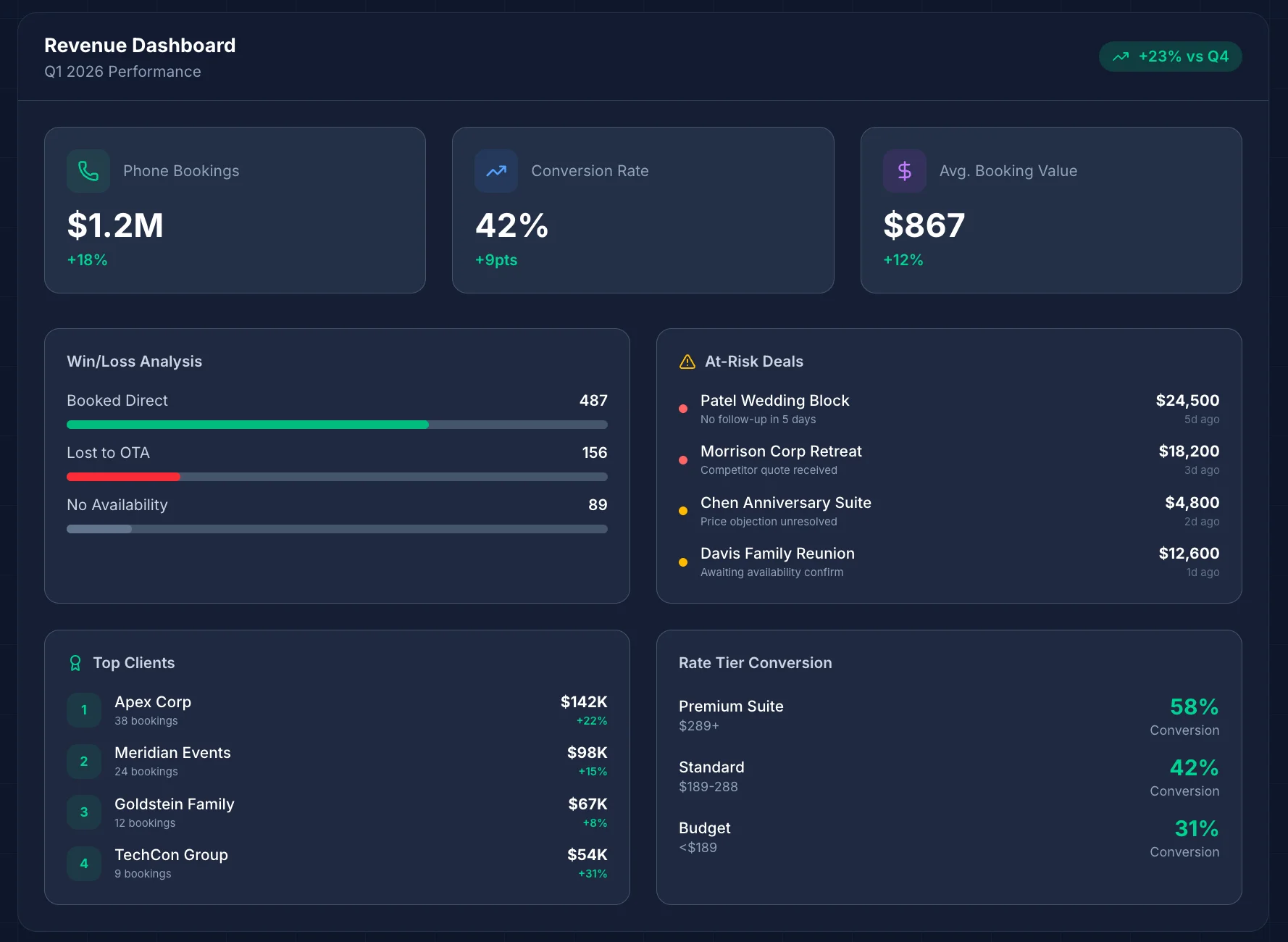
What Properties Using Call Analytics Are Actually Seeing
The results from properties that have adopted conversation intelligence for their reservation teams follow a consistent pattern:
Metric | Outcome |
+15–25% | Improvement in direct booking conversion rate |
+20% | Upsell revenue lift when agents consistently offer upgrades and packages |
100% | Calls scored automatically (vs. 2–5% with manual review) |
40% faster | New agent ramp time using training built from top performer calls |
60% fewer | Negative reviews from calls flagged for service recovery and followed up same-day |
"We were only reviewing 3% of our reservation calls. Now we see everything — and our conversion rate has jumped 22% in six months." — Director of Revenue
These are not overnight transformations. They're the result of making the reservation desk visible — giving management the same level of data and accountability that already exists for the website, the ad campaigns, and every other revenue channel.
Your Reservation Desk Is a Revenue Channel. Start Treating It Like One.
The guest who called your hotel today had intent. They bypassed the OTA. They chose to pick up the phone. Whether they book direct or end up paying you a commission on a third-party platform comes down to what happens in that three-minute conversation.
You now have the scorecard to measure it, the tactics to improve it, and the value stack to compete when OTAs undercut on price.
The question isn't whether these things work. It's whether you can sustain them across 400 calls a month, across every agent and every shift, without the gaps that send guests elsewhere.
Related Articles
Get the Latest Insights
Get the latest insights on call center optimization and AI-powered sales strategies delivered to your inbox.
By subscribing you agree to receive marketing emails. Unsubscribe anytime.