
The Sales Call Audit Guide: How to Review 5 Calls in 30 Minutes (And Walk Into Your Next Meeting With Real Data)
Here's how to audit 5 calls and walk in with coaching ammunition that's backed by data, not memory. A manual guide by Call Optix.

You've got 30 minutes before your next team sync. You want to come in with something concrete. Not "let's tighten up our calls, team." Not a vague motivational push. Something specific enough that your reps actually change what they do on their next call.
Here's how to audit 5 calls and walk in with coaching ammunition that's backed by data, not memory.
One thing upfront: this is a manual exercise. You can't do this every week for every rep across your whole team. But doing it once, for 5 calls, will almost certainly surface something nobody on your team has noticed. And it'll sharpen your ear for every call you listen to afterward.
A note on timing. You're not listening to full calls. If your average sales call runs 20-25 minutes, five full calls would take two hours. That's not the exercise. For each call, skip to the middle third where the discovery-to-pitch transition usually lives. Listen to about 5-6 minutes per call. Use your dialer's timestamps to jump around. You're looking for specific moments, not doing a play-by-play.
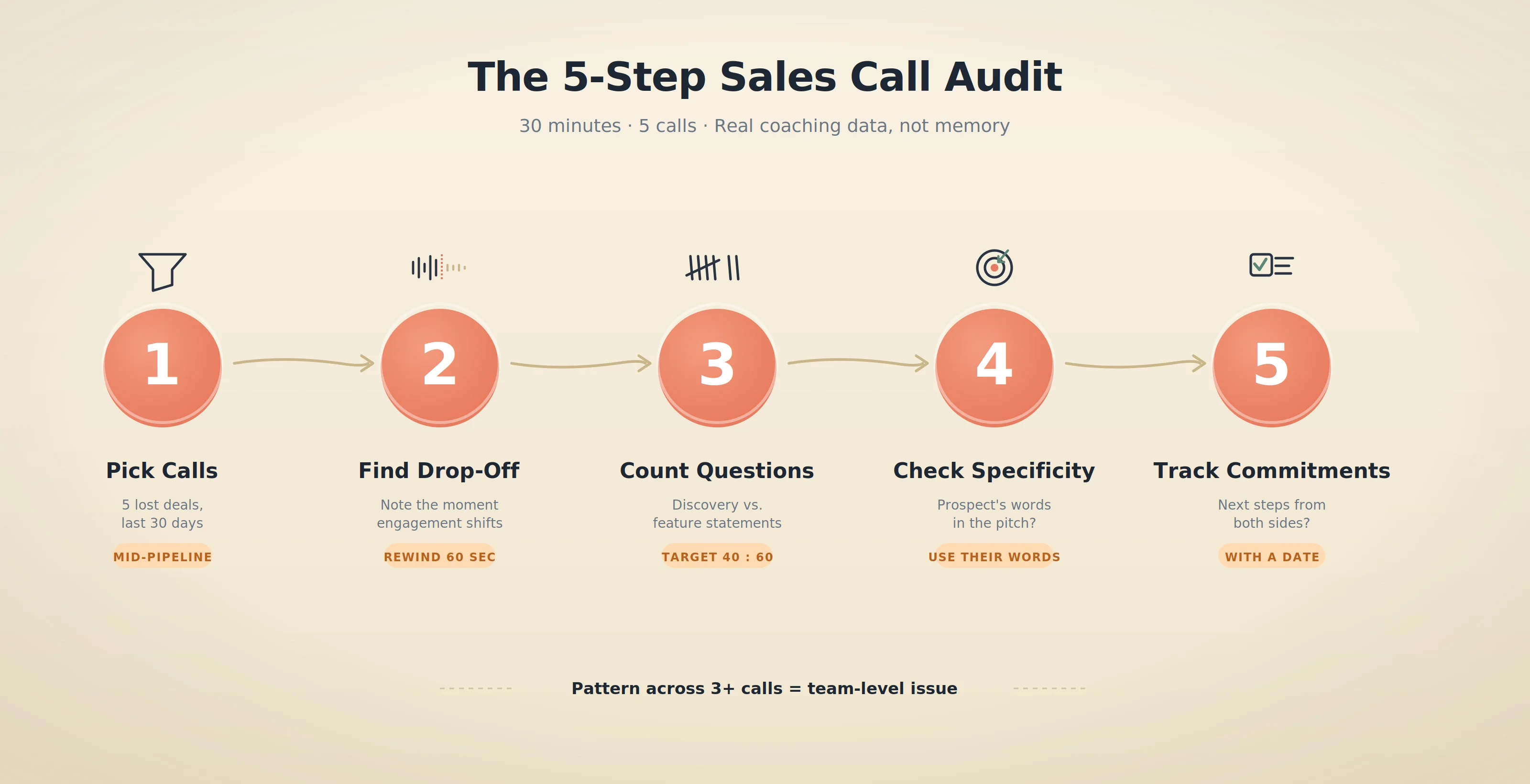
The 5-Step Sales Call Audit Framework
Step 1: Pick the right 5 calls.
This is where most managers already go wrong.
Don't pick randomly. Don't grab the most recent calls from your dialer's dashboard. And definitely don't cherry-pick your weakest rep's calls because you want to prove a point.
Pull from lost deals in the last 30 days. Specifically, deals that made it past the first call but didn't close. These are the ones where something broke mid-process. First-call losses are often just bad fit. Mid-pipeline losses are where the coachable breakdowns live.
Mix it up. Pull calls from 3-4 different reps if possible. If all 5 calls come from one person, you'll learn about that person but you won't learn about your team.
Here's the mistake I see most often: managers pull the longest calls assuming more time equals more content to review. That's backwards. Some of the most revealing calls are the short ones where a prospect disengaged at minute 4 and the rep didn't notice.
Step 2: Listen for the "drop-off moment."
Every call that didn't convert has a moment where the energy shifts. The prospect's responses get shorter. Their questions dry up. They start giving you "yeah" and "makes sense" instead of engaging. Sometimes you can literally hear them checking out.
Find that moment. Note the timestamp.
Then look at what happened in the 60 seconds right before it. That's your diagnostic window. Something the rep did (or didn't do) triggered the shift.
Common triggers you'll find:
- The premature pitch. Rep jumped from discovery to product features before the prospect had finished explaining their problem. The prospect felt unheard.
- The disconnected demo. Rep showed a capability that had nothing to do with what the prospect just said they needed. The prospect mentally checked out because the conversation stopped being about them.
- The monologue. Rep talked for 3+ minutes without asking a single question. By minute two, the prospect was reading emails.
What these sound like in practice:
Before the drop-off: Prospect is giving long, detailed answers. Asking follow-up questions. Sharing internal context voluntarily.
After the drop-off: "Yeah." "Makes sense." "Sure, send it over." Responses shrink to three words or fewer. The conversation goes from dialogue to interview.
You don't need software to spot this. You just need to listen for the shift in energy and then rewind 60 seconds. Once you know what to listen for, you'll start hearing it in every call.
Step 3: Count discovery questions vs. feature statements.
This step is blunt. Literally keep a tally.
Every time the rep asks a genuine discovery question, mark it on one side. Every time the rep describes a product capability or feature, mark it on the other.
The ratio matters more than the absolute numbers.
Top-performing sales reps in most B2B environments run a talk-to-listen ratio around 40:60 or better. They spend more time asking and listening than presenting. If a rep on your team is running 70:30 (talking most of the call), that's your coaching moment right there. You don't need to restructure their whole approach. Just get them asking more questions in the first 5 minutes before they start pitching.
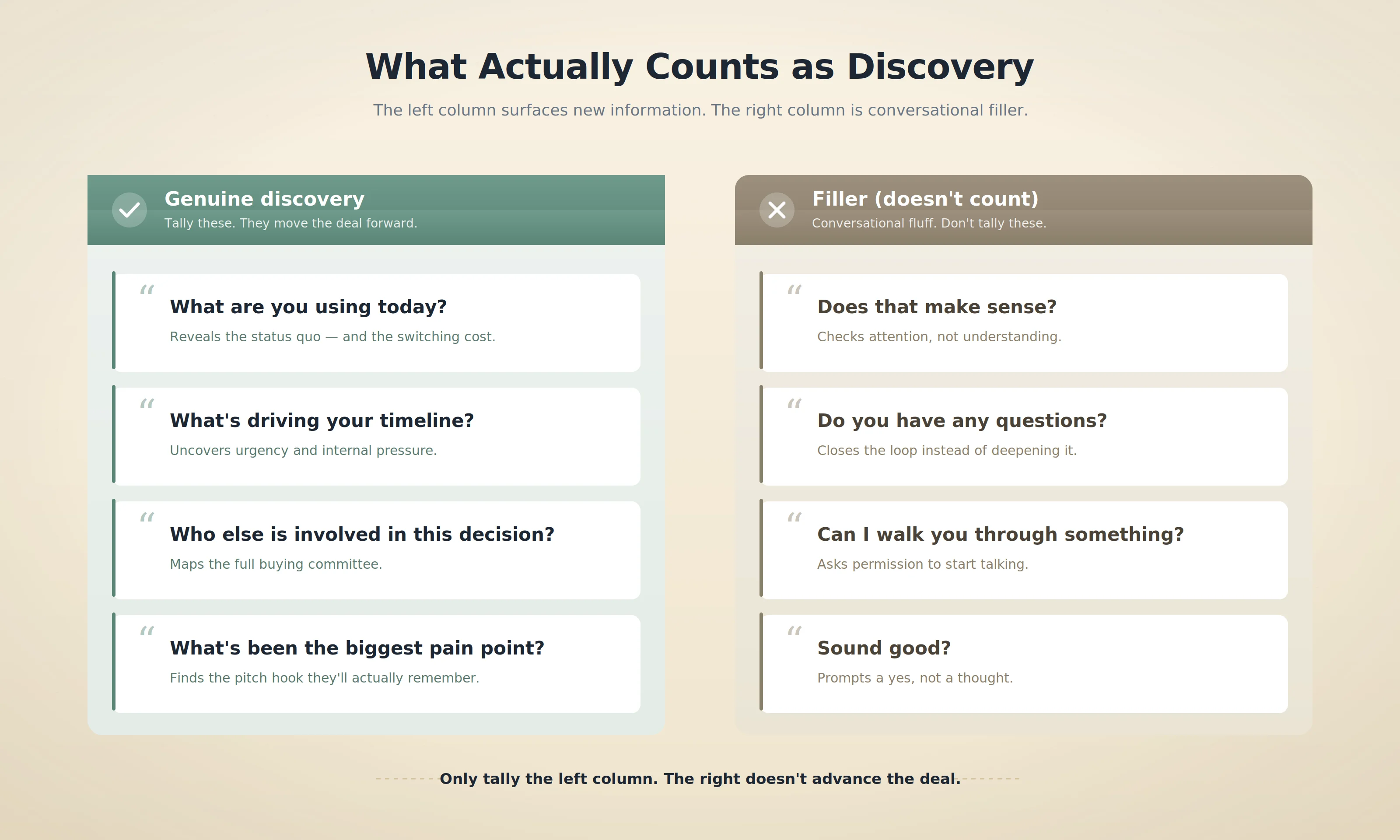
What counts and what doesn't:
Genuine discovery | Not discovery (filler) |
|---|---|
"What are you using today?" | "Does that make sense?" |
"What's driving your timeline?" | "Do you have any questions?" |
"Who else is involved in this decision?" | "Can I walk you through something?" |
"What's been the biggest pain point?" | "Sound good?" |
The left column surfaces new information about the prospect. The right column is conversational filler that doesn't advance the rep's understanding of the deal. Only tally the left column.
Step 4: Check for specificity vs. generic pitching.
This is the subtlest step, and it separates good reps from great ones.
Listen for whether the rep references something specific the prospect said earlier in the call. Did they connect a feature back to the prospect's actual words?
The contrast is stark when you hear it side by side:
Generic: "Our platform helps teams improve efficiency and drive better outcomes."
Specific: "You mentioned your team spends 2 hours a week on manual QA reviews. Here's how we cut that to 15 minutes for a team your size."
Both reps are technically describing the same product. But only one is making the prospect feel like the solution was built for their problem. The generic version could be copy-pasted into any call. The specific version proves the rep was actually listening.
This is one of the hardest things to coach without concrete examples. Which is exactly why you're pulling timestamps. When you sit down with a rep and play back a moment where they went generic, then compare it to a moment (from the same rep or a different one) where they nailed the specificity, the lesson lands instantly. No slide deck needed.
If you audit 5 calls and every rep pitches generically, that's not an individual problem. That's a team-level gap in how your people are trained to connect features to prospect pain.
Step 5: Note commitments made by both sides.
This is the step that consistently surprises managers who haven't done it before.
Listen for every specific promise made during the call:
- Rep commitments: "I'll send you that case study by Thursday." "I'll loop in our solutions engineer." "I'll put together custom pricing for your team size."
- Prospect commitments: "I'll share this with my VP." "I'll send over our current contract so you can compare." "Let me get back to you after our planning meeting next Tuesday."
Write each one down. Then go check your CRM, email, and calendar. Did any of it actually happen?
In most teams, a startling number of these commitments simply vanish. The rep forgets. The prospect moves on. Nobody follows up. And a deal that had momentum quietly stalls because both sides dropped the thread.
What to watch for specifically:
- Vague commitments with no date: "I'll send that over" (when? to whom?)
- Prospect hedge language: "I'll try to get that to you" (this almost never converts to action)
- The rep not confirming next steps before hanging up (the call just... ends)
This step alone is worth the 30 minutes. Even if you find nothing useful in steps 1 through 4 (unlikely, but possible), the commitment audit will almost always reveal something your team needs to tighten up.
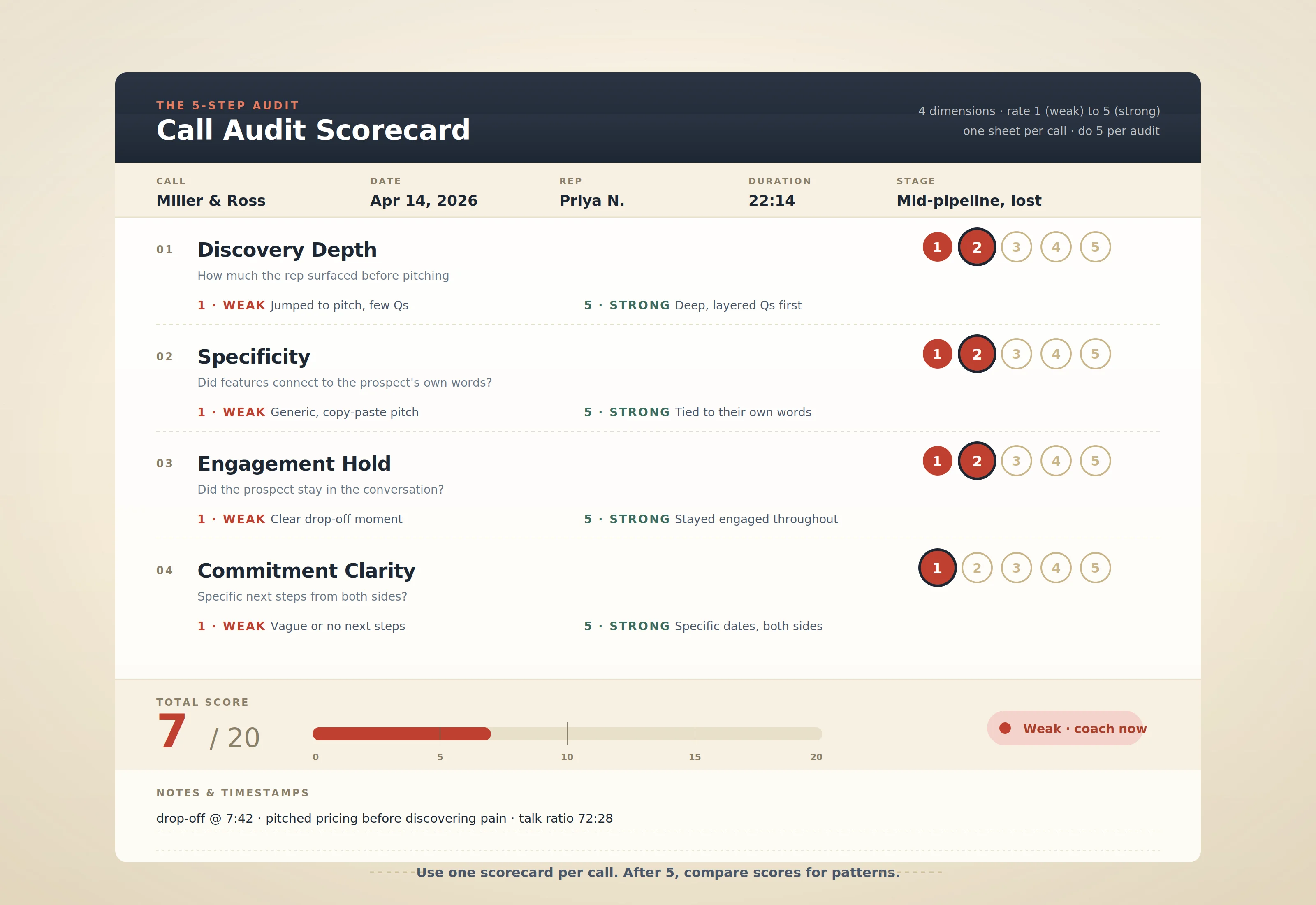
Score What You Found
Before you close your notes, give each of the 5 calls a quick score. Nothing fancy. Just four dimensions, rated 1 to 5:
Dimension | 1 (Weak) | 5 (Strong) |
|---|---|---|
Discovery depth | Jumped straight to pitch, few questions asked | Deep, layered questioning before any product talk |
Specificity | Generic pitch, could apply to any prospect | Connected features to prospect's own words and situation |
Engagement hold | Clear drop-off moment, prospect checked out early | Prospect stayed engaged and asked questions throughout |
Commitment clarity | Vague or no next steps at end of call | Specific commitments with dates from both sides |
That's it. Four numbers per call. Twenty numbers total.
Why bother scoring? Because if you do this exercise again next month, you can compare. A spreadsheet with 3 months of scores will show you whether your coaching is actually moving the needle. Without scores, you're relying on your memory of how calls "felt," which is exactly the problem this whole exercise is designed to fix.
What to Do With What You Find
You've spent 30 minutes with 5 calls. You probably have notes, timestamps, scores, and at least one finding that made you go "huh." Here's how to turn it into action.
If you spotted a pattern across 3 or more calls, it's a team-level issue. Bring it to your team meeting. Don't name reps. Describe the pattern in terms of scenarios. "I noticed that on several calls this month, we jumped to pricing before the prospect had fully described their situation. Here's what that sounded like." Play a 30-second clip if you can. Then ask the team what they'd do differently.
If one rep has a clear gap the others don't, it's a 1:1 conversation. Use the timestamp. Play the moment. Don't lecture. Ask them what they hear. Then ask what they'd do differently next time. Reps coached with their own call audio retain the lesson far better than reps coached with generic advice.
If you reviewed 5 calls and genuinely found nothing, pick 5 different ones. Try a different pipeline stage. Try calls from a rep you haven't listened to in a while. If you're consistently finding nothing, you're probably picking the wrong calls (see Step 1).
What NOT to do with your findings.
This part matters just as much.
Don't build a training program off one bad moment from one call. That's anecdote-driven coaching. It's the equivalent of watching one customer support ticket and redesigning your whole product. If you heard something concerning on a single call, note it, but don't overreact until you've confirmed it's a pattern across multiple calls and multiple reps.
Don't ambush a rep with a call clip in a group setting. Even if you don't say their name, if the team is small enough, everyone will know. Individual gaps get addressed in private 1:1s. Team patterns get addressed in group settings using anonymized, generalized examples.
Don't skip the follow-up. The most common failure mode isn't "manager didn't find anything." It's "manager found something, mentioned it once, and never followed up." If you identified that your team goes generic during pitches, check on it again in two weeks. Listen for whether the behavior changed. Coaching that happens once isn't coaching. It's a suggestion.
One more thing: write down what you found. Even just a few bullet points in a doc. If you do this monthly, you'll start seeing trends over time that you'd never catch from memory.
The Honest Tradeoff
This exercise takes about 30 to 45 minutes for 5 calls. It works. You will find something worth coaching on. I'm fairly confident about that.
The catch is that it doesn't scale.
You can't do this for every rep, every week, across hundreds of calls. The math doesn't work. A 10-rep team running 40 calls each means 400 calls a week. You reviewed 5. That's a 1.25% sample.
But doing it once gives you two things that are genuinely valuable. First, a baseline. You now know what patterns exist on your team's calls, even from a small sample. Second, a sharper ear. Once you've identified what to listen for, your casual spot-checks become dramatically more effective because you know the specific moments that matter.
Start with 5 calls before your next team meeting. Score them. See what you find. Then decide how often it's worth repeating.
Frequently Asked Questions
How do I pick which sales calls to audit?
Focus on lost deals from the last 30 days that made it past the first conversation but didn't close. These mid-pipeline losses contain the most coachable breakdowns. Avoid cherry-picking from a single rep. Pull from 3-4 different reps to get a team-level picture. Don't default to the longest calls either. Short calls where a prospect disengaged early can be just as revealing.
How do I audit 5 sales calls in only 30 minutes?
You don't listen to full calls. Skip to the middle third of each recording where the discovery-to-pitch transition typically lives, and listen to about 5-6 minutes per call. Use your dialer's timestamps to jump to key moments: the pricing discussion, the prospect's first objection, and the final 2 minutes where next steps should be set. You're looking for specific patterns, not doing a play-by-play of the entire conversation.
What is a "drop-off moment" in a sales call?
A drop-off moment is the specific point in a sales conversation where prospect engagement measurably declines. You'll hear it as shorter responses, fewer questions, and generic affirmations like "yeah" and "makes sense." The most useful diagnostic step is to note the timestamp of the shift and then review the 60 seconds before it. Common triggers include premature pitching, disconnected product demos, and extended rep monologues lasting three or more minutes.
What is a good talk-to-listen ratio for sales calls?
Top-performing B2B sales reps typically maintain a talk-to-listen ratio around 40:60 or better, meaning they spend more time asking questions and listening than presenting. Average performers often run at 60:40 or 70:30. The highest-impact coaching adjustment is usually to increase the number of genuine discovery questions in the first five minutes before any product discussion begins.
How many sales calls should I audit to find coaching insights?
Five calls is enough to surface at least one actionable coaching insight, provided you select the right calls: mid-pipeline losses from the last 30 days, spread across multiple reps. Look for patterns across 3 or more of the 5 calls to identify team-level issues. Doing this exercise monthly with different call selections will reveal trends over time that a single session won't catch.
What should I do if I find a problem on only one sales call?
Note it, but don't overreact. One bad moment on one call is an anecdote, not a pattern. If a single rep has a clear gap, address it in a private 1:1 coaching session using the specific timestamp from the call. Avoid building team-wide training programs around isolated incidents. If you want to confirm whether it's a broader issue, audit 5 more calls from different reps and check whether the same pattern appears.
Related Articles


Get the Latest Insights
Get the latest insights on call center optimization and AI-powered sales strategies delivered to your inbox.
By subscribing you agree to receive marketing emails. Unsubscribe anytime.