
What Would It Actually Cost to QA 100% of Your Calls With AI?
See what it really costs to QA every call with AI—and how manual, per-seat and usage pricing compare when coverage, capabilities and business value are included.
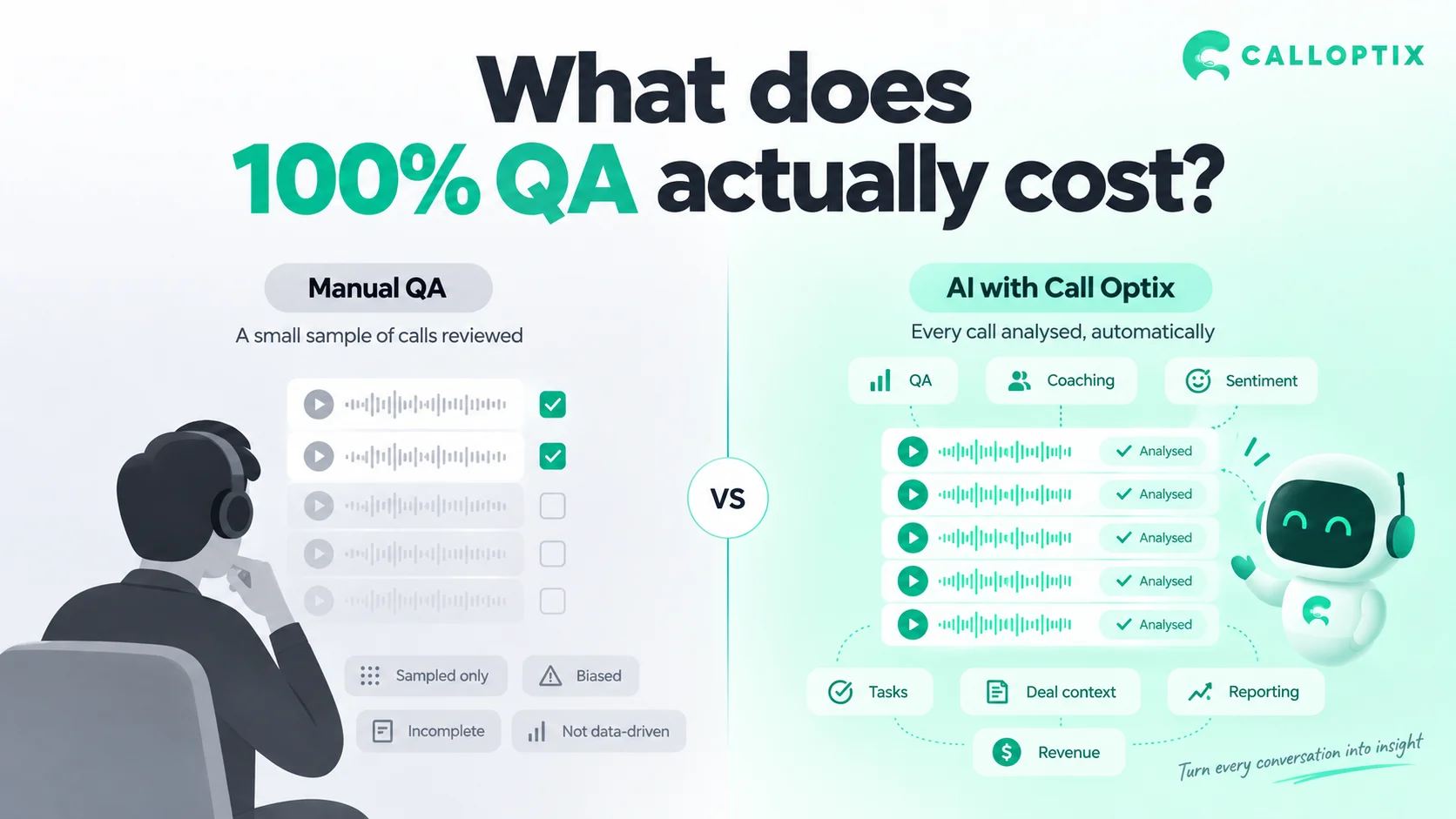
Most contact centers do not have a QA problem because their team reviews calls badly.
They have a coverage problem.
A QA manager may do excellent work, but humans can only listen to so many conversations. That means most calls are never reviewed, and managers are left hoping that the small sample they selected accurately represents what is happening across the rest of the team.
AI changes that equation.
Instead of asking:
How much does QA cost today?
A more useful question is:
What would it actually cost to understand every customer conversation?
And once you ask that question, pricing becomes more complicated than comparing a QA analyst's salary with an AI subscription.
Some platforms charge per agent.
Some charge by usage.
Some impose usage allowances.
Some separate transcription, AI scoring, analytics or coaching into different tiers.
Others require an enterprise contract.
And even when two products both advertise “AI QA,” they may be doing completely different amounts of work after each call.
So the real comparison is not:
Which tool has the lowest advertised price?
It is:
How much does it cost to get the level of coverage, analysis and action your business actually needs?
The short answer
AI can make reviewing 100% of your calls economically practical.
Manual QA often looks inexpensive because only a small percentage of calls are being reviewed.
But a small monthly QA bill and complete call coverage are not the same product.
Once you compare manual QA and AI at similar levels of coverage, the economics change quickly.
There is another important distinction.
The cheapest AI tool is not necessarily the cheapest complete solution.
A useful buying decision has to account for:
- how many calls are actually analysed
- how much your team talks
- whether usage is capped
- what the AI actually analyses
- what happens after a problem is detected
- whether additional software is required to turn the analysis into action
That last point matters more than it initially appears.
There is a major difference between software that:
scores a conversation
and software that can:
score it, identify what happened, extract customer information, create follow-up actions, preserve deal context, help managers coach the agent and carry the intelligence into the rest of the business.
Those are not equivalent products.
So they should not be compared as though they are.
Why AI call QA pricing is so difficult to compare
Vendors frequently price completely different products using completely different units.
Pricing model | What looks attractive | What you need to verify |
|---|---|---|
Manual QA | Small current monthly bill | How few calls are actually reviewed |
Per-seat AI | Simple monthly price per agent | Included usage, limits and feature tier |
Usage-based AI | Cost follows conversation volume | Rate, allowances and included functionality |
Enterprise suite | Broad capabilities | Implementation, modules, credits and contract price |
That is why comparing:
“$X per agent”
against:
“$Y per minute”
does not tell you which platform is actually cheaper.
First, you need to make the products comparable.
The per-seat price can be misleading
Per-seat pricing feels simple:
number of agents × price per agent
But a seat does not automatically mean unlimited call analysis.
For example, Enthu currently publishes an AI plan priced per agent that also includes a defined monthly usage allowance. Its published capabilities include transcription, summaries, sentiment, scorecards, automated scoring and QA workflows.
That may be an excellent fit for some businesses.
But the important point is:
A price per agent is not automatically the price of unlimited analysis.
Call Coach IQ similarly publishes a starting per-agent price alongside higher product tiers.
So simply taking the lowest advertised seat price and comparing it with another company's full platform cost can create a misleading result.
Before comparing any seat-based product, ask two questions:
How much conversation volume is actually included?
And:
Does this tier include everything we need the platform to do?
Two teams with the same headcount can generate completely different workloads
Headcount alone is a poor predictor of conversation volume.
Imagine two contact centers with exactly the same number of agents.
One team spends only part of the working day speaking with customers.
The other spends most of the day on calls.
Their software seat count may be identical.
Their actual conversation volume is not.
One company may produce several times more audio for AI systems to transcribe, analyse, classify and score.
Seat-based pricing can hide that difference.
Usage-based pricing exposes it.
Neither model is inherently better.
But for businesses trying to understand the true economics of analysing every call, conversation volume is usually more useful than headcount alone.
What should count as a fully analysed call?
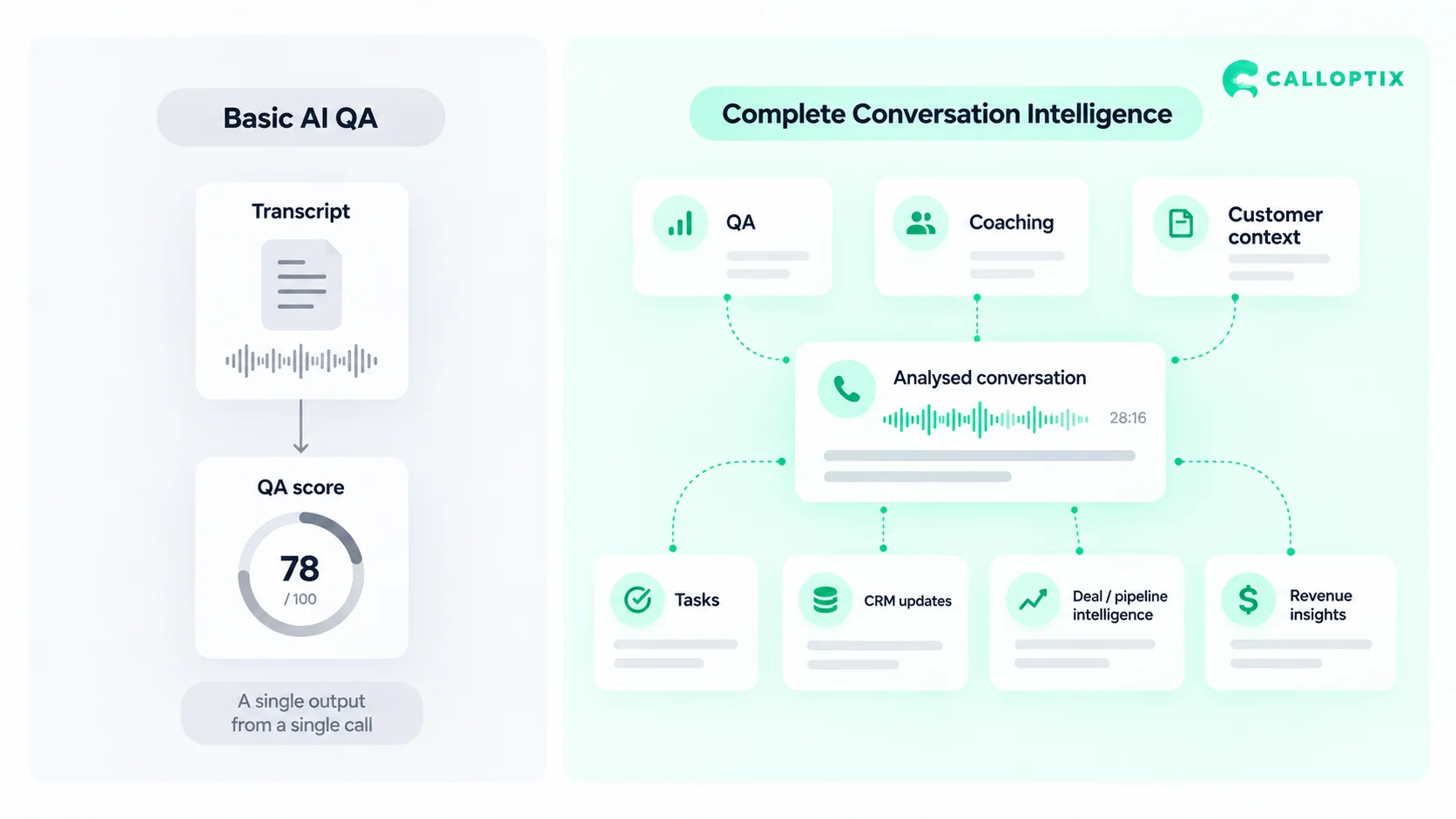
This is where many pricing comparisons fall apart.
Transcribing a conversation is useful.
Scoring it against a QA rubric is useful.
But there is far more business information inside a customer conversation than a QA score.
A complete conversation analysis can include:
Quality and compliance
- transcription and speaker separation
- custom QA scorecards
- script adherence
- compliance monitoring
- coaching opportunities
Conversation understanding
- summaries
- sentiment
- call outcome
- objections
- pain points
- competitor mentions
Customer intelligence
- requirements
- preferences
- structured customer information
- commitments
- customer context
- journey information
Action and commercial intelligence
- follow-up tasks
- lead information
- deal context
- pipeline information
- CRM updates
- management reporting
- revenue intelligence
Not every company needs every one of these capabilities.
That is important.
But if your business does need them, comparing the cost of a narrow QA point solution against a broader conversation-intelligence platform is not an apples-to-apples comparison.
Do other AI QA platforms provide these capabilities?
Many provide parts of the list.
Some are excellent QA products.
Enthu, for example, publicly lists capabilities such as transcription, summaries, sentiment, scorecards, automated evaluation, coaching workflows and reporting.
Scorebuddy provides sophisticated QA, calibration, coaching and analytics, while features such as AI scoring, conversation analytics and transcription can depend on package and AI-credit structure.
Observe.AI goes significantly further and operates as a broad enterprise contact-center AI platform with capabilities including Auto QA, interaction intelligence and coaching.
Its buying model, however, is oriented around enterprise sales and custom deployments rather than simple public self-service pricing.
ConvoQC operates at another end of the market. It publishes very low usage-based pricing, but describes itself as a more specialized QC platform focused on areas such as compliance, fraud and publisher-quality workflows.
This is why the market should not be reduced to:
cheap AI vs expensive AI.
The more useful question is:
How much of the workflow are you actually buying?
This is where Call Optix changes the comparison
Call Optix is not trying to be the cheapest transcription engine.
It is not trying to win simply by producing the cheapest QA score.
The more meaningful comparison is:
How much useful work can the business get from each analysed conversation?
Call Optix combines several layers of conversation intelligence in one platform.
QA and coaching
- performance scorecards
- automated coaching triggers
- coaching workflows
- leaderboards and benchmarks
Conversation intelligence
- transcription
- summaries
- sentiment
- dynamic tagging
- objection analysis
- pain-point extraction
- competitor mentions
Customer context and action
- automated task creation
- customer profiles
- customer journey context
- custom data extraction
- lead management
Commercial intelligence
- pipeline management
- deal management
- revenue intelligence
- business intelligence dashboards
Call Optix also supports integration with existing phone systems, with more than 20 telephony integrations listed, and integration included in its plans.
Compliance monitoring can also be added where businesses need rule-based compliance analysis.
So instead of asking:
“How much does it cost to score this call?”
you can ask:
“How much does it cost to turn this conversation into QA, coaching, customer context, follow-up actions and useful business intelligence?”
That is a very different unit of value.
But what if you do not need everything Call Optix provides?
You may not.
And this is an important part of the pricing comparison.
Not every team needs QA, coaching, customer profiling, pipeline intelligence, revenue reporting and workflow automation from day one.
You should not have to choose between:
a narrow point solution
and:
paying for an entire capability set your business does not currently require.
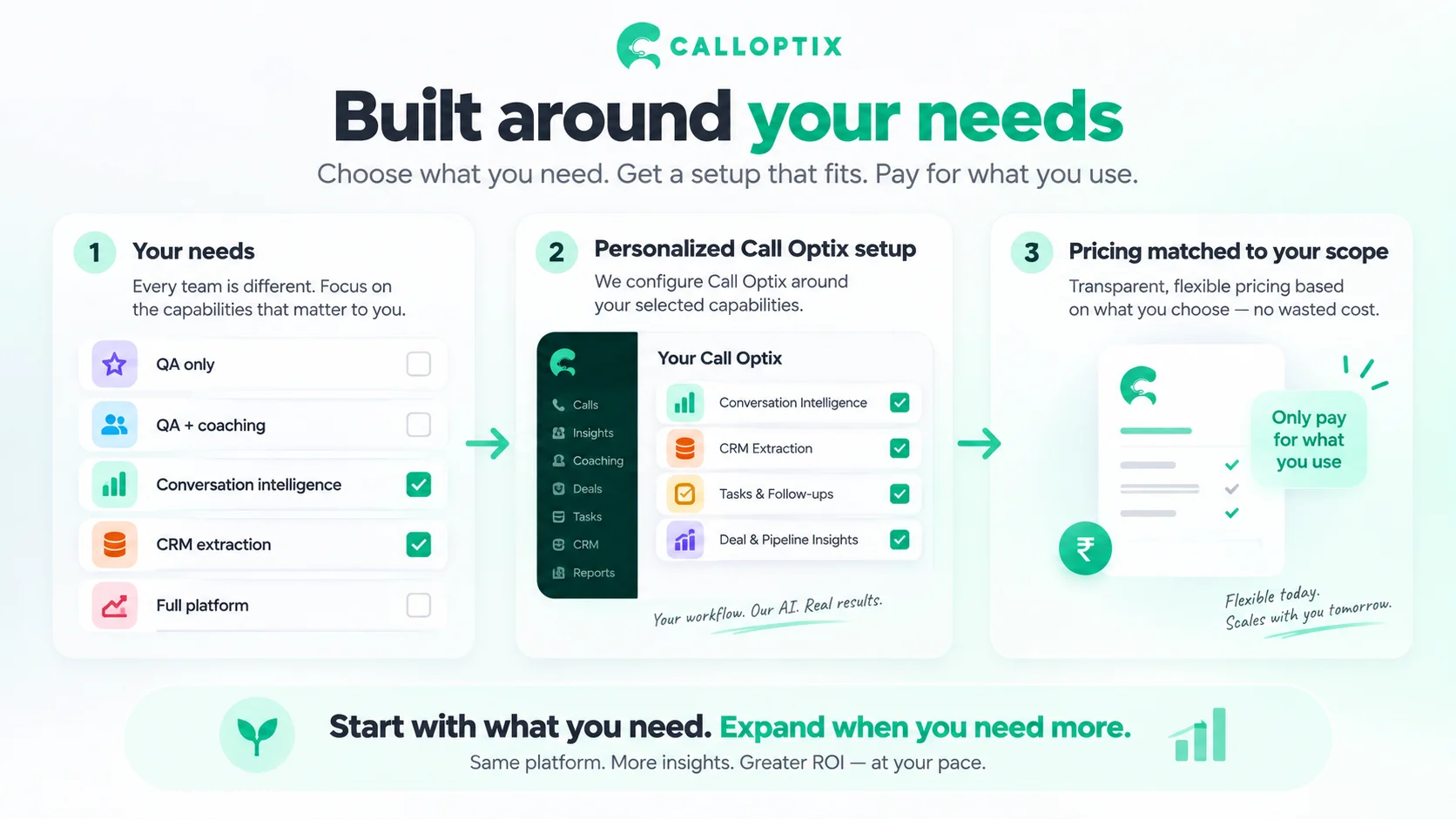
Call Optix can also be configured around the functionality your business actually needs, with pricing tailored to that scope.
For example, you may primarily need:
- automated QA and custom scorecards
- transcription, summaries and sentiment
- QA plus coaching
- customer-data extraction and CRM updates
- conversation intelligence without broader pipeline features
In that situation, the conversation does not have to begin with:
“Which complete Call Optix package do I have to buy?”
It can begin with:
“What exactly do we want to analyse, extract and automate?”
The solution can then be personalized around that requirement.
This makes comparisons with lower-priced point solutions much more meaningful.
If another product appears cheaper because it performs only one part of the workflow, the correct comparison is not necessarily:
that narrow product vs every Call Optix capability.
Instead:
Compare it against the Call Optix solution configured around the same requirement.
And if your requirements grow later, the same platform can expand into coaching, customer intelligence, workflow automation, deal context and business intelligence without forcing you to replace your underlying conversation-analysis system.
That gives Call Optix an important advantage:
Completeness when you need it. Flexibility when you don't.
What does complete call analysis cost with Call Optix?
This is the section where the numbers actually matter.
Call Optix publishes both the monthly price and included analysis volume for its standard plans.
Using a five-minute average conversation:
Call Optix plan | Included analysis | Approx. 5-minute calls | Effective included cost per analysed call* |
|---|---|---|---|
Starter | 2,500 minutes | 500 | ~$0.30 |
Growth | 11,000 minutes | 2,200 | ~$0.27 |
Scale | 30,000 minutes | 6,000 | ~$0.25 |
Based on fully using the included monthly analysis capacity. Actual effective cost varies with utilization, optional capabilities and overage usage.*
Published standard pricing is currently:
- Starter — $149/month
- Growth — $599/month
- Scale — $1,499/month
Enterprise plans provide customized analysis volume and volume pricing for larger deployments.
And, importantly, companies with more focused requirements can discuss a personalized configuration and pricing structure rather than assuming they must buy the entire platform capability set.
That distinction matters.
The goal is not to force every business into the largest possible package.
The goal is to match the cost with:
the conversation volume you generate + the intelligence you actually need.
Is AI cheaper than manual QA?
For equivalent coverage, it can be dramatically cheaper.
Manual QA can still produce the smallest monthly invoice when humans review only a small sample of conversations.
But that is precisely the problem.
Most calls remain unseen.
So:
A cheaper sample is not the same thing as cheaper coverage.
Published manual-QA estimates commonly place the cost of reviewing an individual call at around a dollar or more.
The exact figure will vary significantly depending on salary, geography, complexity, call duration and QA process.
But the underlying scaling problem does not change.
Every additional conversation requires additional human review time.
AI separates analysis capacity from human listening time.
That allows managers to shift their attention away from manually finding problems and toward the areas where human judgment is actually valuable.
What about a cheaper AI QA product?
A focused QA product can certainly have a lower advertised price.
But make sure you are comparing the same requirement.
If you only need a limited subset of Call Optix capabilities, Call Optix can tailor the solution and pricing around those requirements rather than forcing you into the broadest possible implementation.
That leads to a more useful comparison:
Narrow requirement?
Compare narrow solutions.
Broader requirement?
Compare the complete workflow.
Call Optix becomes increasingly compelling as requirements expand because the same platform can bring together:
QA + coaching + conversation intelligence + customer-data extraction + follow-up automation + pipeline context + CRM workflow + business intelligence
Without those capabilities inside the conversation platform, companies often end up assembling them elsewhere through combinations of:
- QA software
- transcription software
- automation platforms
- CRM enrichment
- reporting tools
- coaching systems
- integration middleware
That creates an important pricing trap:
The cheapest individual tool can produce a more expensive overall operating stack.
This is why completeness has to be part of the cost calculation.
But Call Optix does not require completeness to become an all-or-nothing proposition.
Businesses that need a smaller scope can begin with a more focused implementation and expand as requirements grow.
Predictability matters as much as the headline price
Usage-based pricing is sometimes criticized for being unpredictable.
It does not have to be.
Call Optix's standard plans use defined monthly analysis allowances, agent limits and published prices.
That gives buyers two useful things:
a known base commitment
and
a measurable relationship between conversation volume and cost.
Growth and Scale plans also support minute rollover, while larger deployments can move to negotiated Enterprise capacity.
Businesses can therefore estimate their costs using actual call volume rather than relying entirely on employee headcount.
And when the standard plans do not reflect the actual feature requirement, a more personalized configuration can be discussed.
This gives businesses three ways to control the economics:
scope
usage
capacity
That is more useful than simply asking which vendor has the smallest number printed on its pricing page.
How to calculate your own AI QA cost
You really need to establish three things.
1. How much conversation volume does your team generate?
Do not estimate this from agent count.
Use actual call duration.
2. What do you actually want the AI to do?
Do you only need QA scoring?
Or do you also need coaching, extraction, customer context, follow-ups, pipeline intelligence or CRM workflows?
3. How much of your call volume do you want analysed?
For companies moving to AI QA, the answer is increasingly:
all of it.
Use real recordings to make this decision.
Call Optix offers a 14-day trial covering the first 100 calls, and existing call recordings can be uploaded for analysis.
That means the trial can be used for more than evaluating the interface.
Take a representative sample of your real calls.
Measure their duration.
See what information the system extracts.
See which capabilities actually matter to your managers and agents.
Then choose—or personalize—the solution around your real requirement.
So which pricing model actually wins?
There is no universal cheapest AI QA pricing model.
And that should not be the goal.
A narrow point solution may have the lowest advertised entry price.
Some teams may benefit from a particular seat-based structure.
Large enterprises may require the governance and infrastructure of a major enterprise contact-center platform.
But for SMB and mid-sized teams trying to move from sampled QA toward complete conversation intelligence, Call Optix has a particularly strong position.
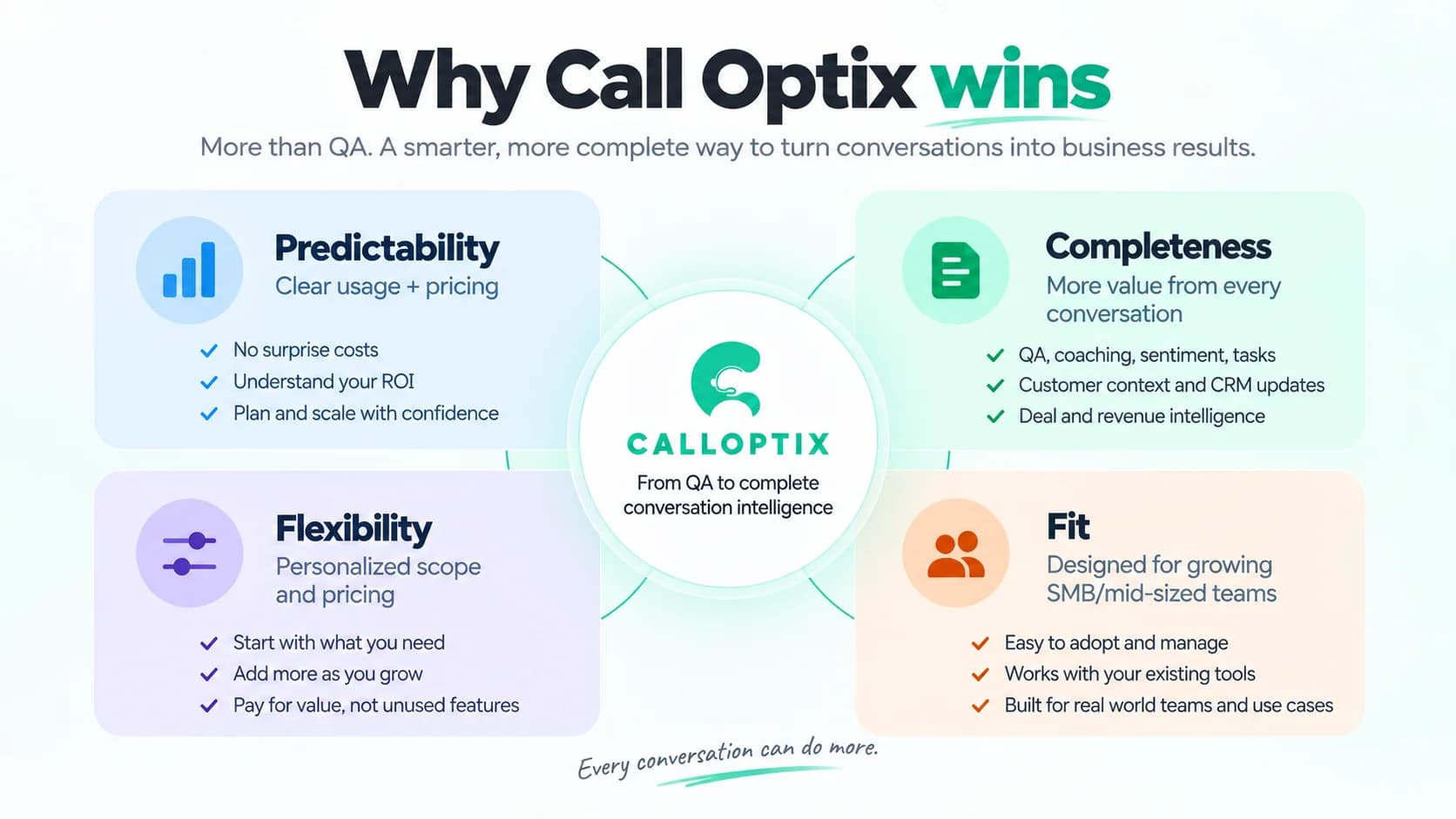
There are four reasons.
1. Predictability
Published plans and included analysis volume make it possible to understand the relationship between usage and cost before committing.
You are not estimating the economics from agent count alone.
2. Completeness
A single analysed conversation can contribute to:
QA.
Coaching.
Sentiment.
Customer intelligence.
Tasks.
Custom extraction.
Deal context.
Pipeline visibility.
Revenue intelligence.
Management reporting.
The value of the conversation does not end when a score is generated.
3. Flexibility
You may not need all of that functionality.
That does not mean you automatically need a completely different product.
Call Optix can be configured around a more focused set of requirements, with pricing tailored accordingly.
You can start with the capabilities you actually need and expand as the value of conversation intelligence grows inside the organization.
4. Fit
Call Optix is particularly well suited to the kind of SMB and mid-sized teams that have reached the point where manual QA no longer scales but do not necessarily want the cost, complexity or implementation burden of a large enterprise contact-center platform.
That gives businesses room to start practical and expand over time.
You are therefore not simply buying:
the cheapest possible AI score.
You are choosing:
how much useful business outcome you want from every customer conversation—and paying for the scope that actually makes sense for your company.
That is the more meaningful comparison.
FAQ
How much does it cost to QA every call with AI?
It depends on call volume, average conversation duration and how much analysis you expect the software to perform.
The most useful metric is often the effective cost per fully analysed conversation, rather than simply comparing per-seat or per-minute pricing.
Is per-seat AI QA cheaper than usage-based AI QA?
Sometimes.
But you first need to confirm the seat's included usage, limits and feature tier.
A per-seat headline price should not automatically be interpreted as unlimited analysis.
Is AI QA cheaper than manual QA?
For comparable coverage, generally yes.
Manual QA may create a lower monthly bill when humans review only a small percentage of conversations.
But sampled QA and complete QA are different levels of coverage.
Do I have to buy every Call Optix feature?
No.
Businesses that only require a more focused subset of Call Optix capabilities can discuss a personalized solution and pricing structure around those requirements.
This allows companies to start with the functionality that provides immediate value rather than paying for unnecessary complexity.
What if I only need QA scoring?
Then compare products based specifically on that requirement.
A focused QA product may make sense.
Call Optix can also be scoped around more focused requirements, while giving you the option to add coaching, customer intelligence, automation, CRM workflows or commercial intelligence later without rebuilding your conversation-analysis stack.
Does AI mean we no longer need QA managers?
No.
AI is well suited to analysing every conversation consistently.
Humans remain important for calibration, disputed scores, unusual situations, management decisions and coaching.
The better model is:
AI reviews everything. Humans focus where judgment creates value.
What should I compare besides price?
Ask what happens after the conversation is analysed.
Does the platform simply provide a score?
Or can it:
- identify what happened
- explain why it matters
- extract relevant customer information
- create the next action
- help coach the employee
- preserve customer and deal context
- carry that intelligence into the rest of the workflow
That difference can matter far more than a few cents in the advertised unit price.
The real question
Do not ask only:
“Which AI QA tool has the lowest advertised price?”
Ask:
“What does it cost to understand every customer conversation—and how much useful work happens after that analysis?”
A cheap QA score can be valuable.
But a conversation that becomes:
a QA score
a coaching opportunity
structured customer context
a follow-up task
pipeline intelligence
and a business signal
is considerably more valuable.
And if your business does not need all of those capabilities yet, your solution does not have to include all of them yet.
That is where the Call Optix model becomes particularly compelling:
Complete when you need it. Personalized when you don't. Predictable as you grow.
For businesses moving from sampled QA toward complete conversation intelligence, that is the comparison that matters.
Related Articles
Get the Latest Insights
Get the latest insights on call center optimization and AI-powered sales strategies delivered to your inbox.
By subscribing you agree to receive marketing emails. Unsubscribe anytime.