
5 Best Contact Enrichment Tools for Sales Teams in 2026
Compare five leading contact enrichment tools for B2B sales teams—and learn how intent and conversation context make CRM records more useful after every call.
Your CRM is full of contact data, so why do your reps still have to research every lead before a call?
That question exposes the real limitation of traditional contact enrichment.
A rep can have a verified email address, direct phone number, job title, company size, industry, location, and technology stack—and still open LinkedIn, the company website, old CRM notes, and previous call records before dialing.
The reason is simple: contact enrichment is no longer enough on its own.
Before a sales call, teams increasingly need four kinds of context:
- 1Identity: Who is this person and how do we reach them?
- 2Fit: Is this company actually a good match for us?
- 3Intent: Why might now be the right time to call?
- 4Relationship context: What has this buyer already told us—requirements, objections, preferences, timeline, commitments, and next steps?
Traditional enrichment tools are very good at the first two, and many now add intent signals. But once a prospect has spoken to your business, some of the most valuable enrichment data no longer comes from an external database. It comes from the conversations your team is already having.
That changes how sales teams should evaluate enrichment software in 2026.
This guide compares five of the strongest contact enrichment options for B2B sales teams—Clay, Apollo, ZoomInfo, Cognism, and HubSpot—and then looks at the missing layer that matters most for call-heavy teams: conversation-derived enrichment.
Best contact enrichment tools: quick comparison
Tool | Best for | Main strength | Intent / signals | CRM enrichment | Pricing approach |
|---|---|---|---|---|---|
Clay | RevOps and GTM teams building custom enrichment workflows | Multi-provider waterfalls plus AI research | Yes | Yes on higher tiers | Free plan; paid usage-based tiers |
Apollo | SMB and mid-market sales teams wanting an all-in-one platform | Contact data, enrichment, prospecting, workflows, and intent together | Yes | Yes | Free; Basic from $49/user/month billed annually |
ZoomInfo | Larger B2B sales and RevOps teams | Broad GTM intelligence across contacts, companies, and signals | Yes | Yes | Subscription pricing based on functionality, users, and records |
Cognism | Teams selling into EMEA or prioritizing verified mobile data | Compliance-focused B2B data and phone verification | Yes on Pro | Yes | CRM Enrichment from $12,000/year |
HubSpot Data Enrichment | Teams already operating inside HubSpot | Native enrichment inside the CRM | Yes, via Buyer Intent | Native | Enrichment included in eligible paid plans; some intent features use credits |
These product and pricing details were checked against current vendor documentation. Clay now uses Actions plus Data Credits across its newer pricing model; Apollo lists Basic at $49/user/month billed annually; Cognism currently lists CRM Enrichment from $12,000/year; HubSpot includes standard data enrichment in eligible paid plans, with some intent capabilities consuming HubSpot Credits; and ZoomInfo states that subscription pricing varies with functionality, users, and records under management. Clay
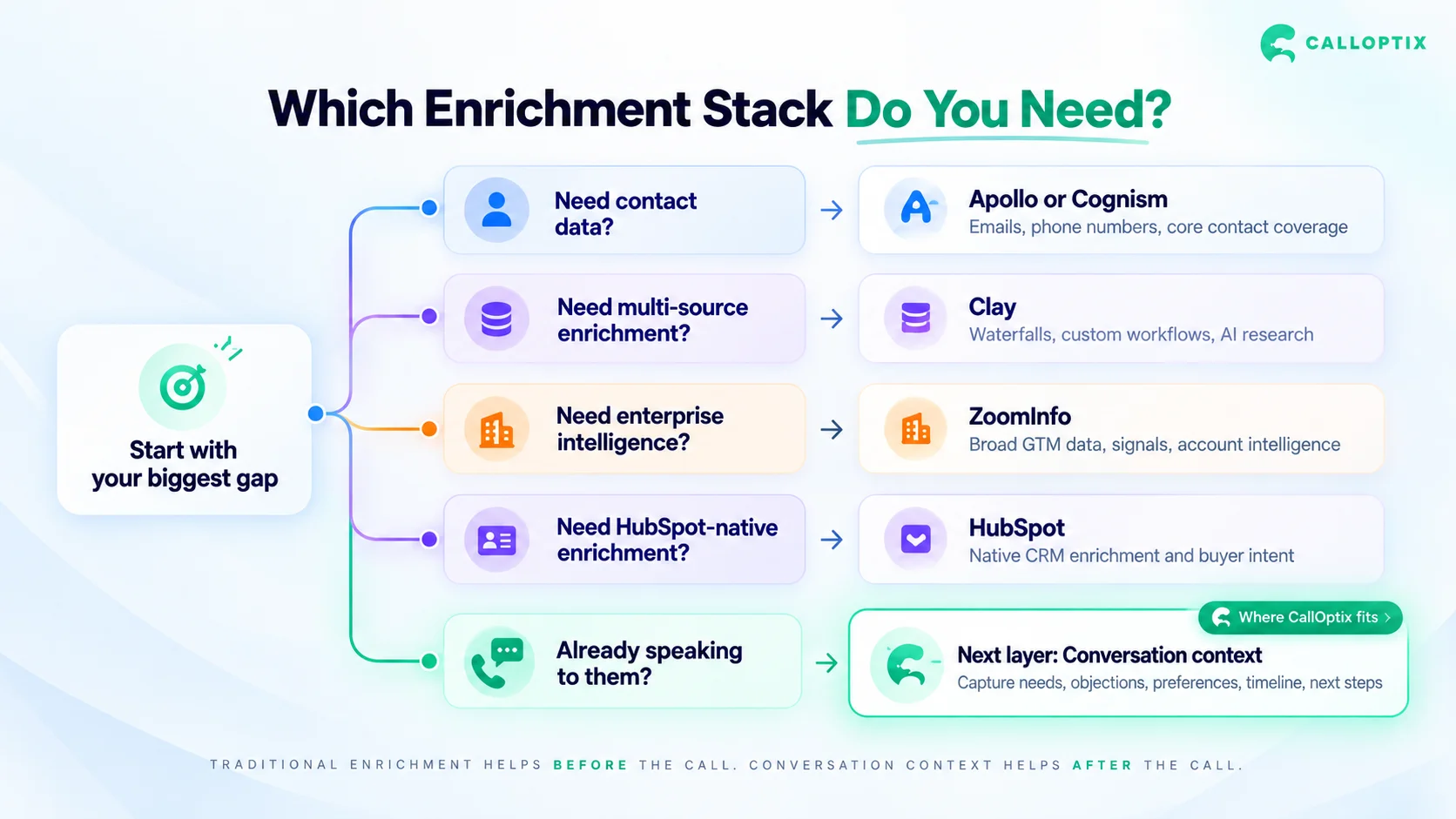
Our short version: choose Clay if you want to orchestrate multiple enrichment sources; Apollo if you want one reasonably consolidated SMB sales stack; ZoomInfo if you need a broader enterprise GTM intelligence layer; Cognism if EMEA and verified mobile data matter heavily; and HubSpot if your team already lives in HubSpot.
But do not stop the evaluation there. If your reps regularly speak to the same prospects more than once, ask a second question:
What happens to everything the buyer tells us after the call ends?
That is where traditional enrichment begins to run out of answers.
How we evaluated these tools
This is not a ranking based on who claims the largest database.
Database size alone does not tell you whether a provider will perform well against your ICP, geography, seniority mix, or phone-first sales motion.
We looked at five more practical questions:
- Coverage model: Does the platform rely primarily on its own dataset, or can it use multiple providers?
- Freshness: Can it update stale records, detect job changes, or run scheduled enrichment?
- Signals and intent: Can it help a rep understand why an account may be worth contacting now?
- Workflow fit: Can enrichment flow into the CRM and the systems reps already use?
- Value after the first touch: Does the stack get smarter once the buyer starts interacting with your company?
The last criterion is deliberately broader than a normal “best enrichment tools” comparison. That is because a complete sales context is not just third-party data.
Contact enrichment has become a four-layer problem
Traditional contact enrichment usually starts with a thin record and fills in missing fields.
For example:
Before enrichment
Jane SmithAcme Ltd.jane@acme.com
After enrichment
VP Sales180 employeesB2B SaaSLondonVerified business phoneLinkedIn profileSalesforce user
That is useful. It gives the rep a much better understanding of who Jane is and whether Acme fits the ICP.
But it may still leave the most important pre-call questions unanswered:
- Has the account recently shown buying intent?
- Has Jane changed roles?
- Is Acme actively researching this category?
- Has Jane already spoken to someone on our team?
- What did she care about in that conversation?
- What concern stopped the deal from moving forward?
- Did she ask for a specific feature, integration, or pricing option?
- What communication preference or follow-up timing did she give us?
A useful way to think about enrichment in 2026 is as four layers:
Layer | Main question | Typical examples |
|---|---|---|
Contact enrichment | Who is this person? | Email, phone, title, LinkedIn |
Company enrichment | Is this account a fit? | Industry, size, revenue, location, tech stack |
Intent enrichment | Why might now be the right time? | Research activity, website visits, hiring, funding, leadership change |
Conversation enrichment | What does this buyer actually want? | Needs, preferences, objections, timeline, commitments, next step |
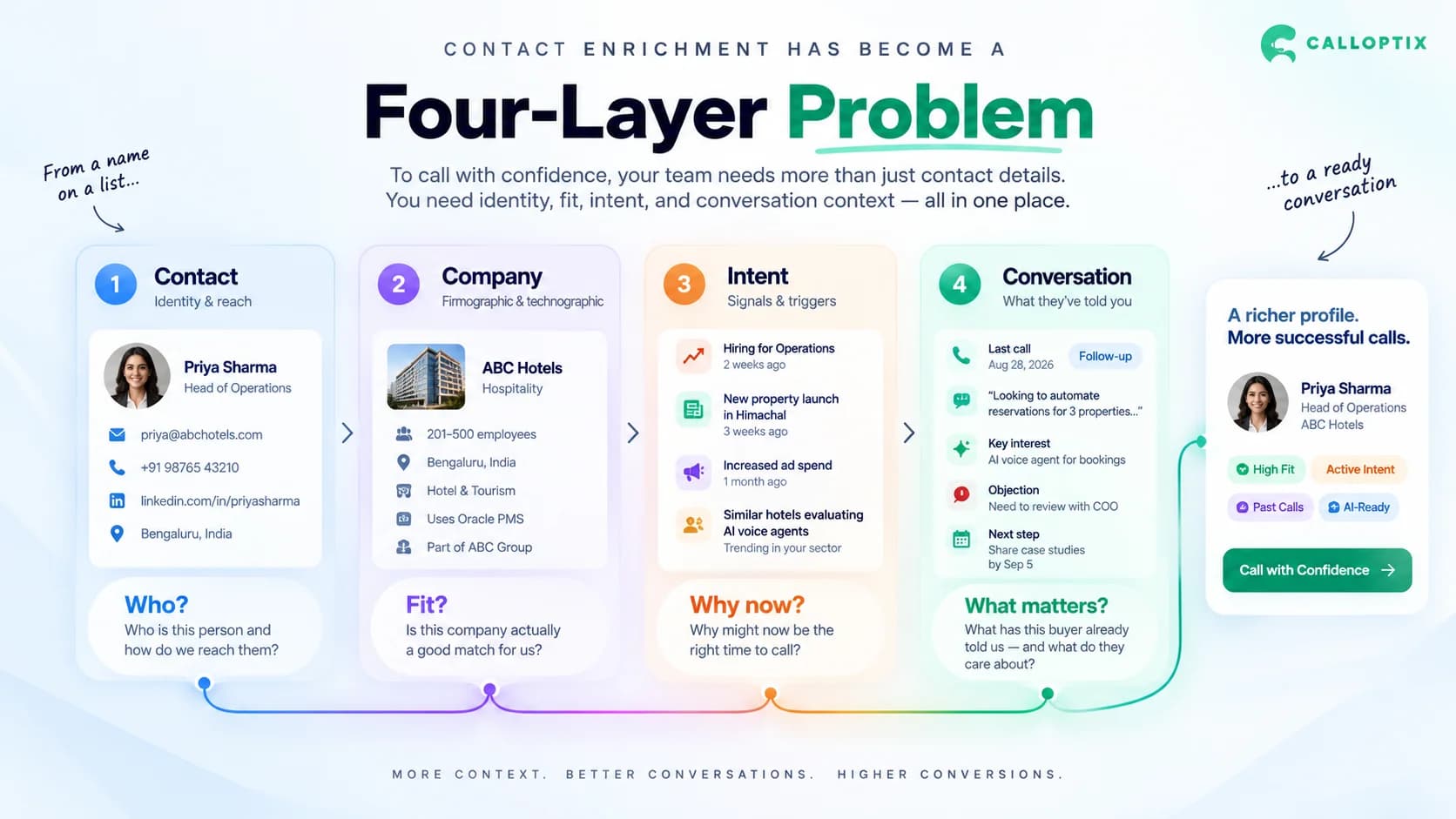
The best stack depends on which layer is currently missing.
In this guide, conversation enrichment is a practical label for turning information learned during customer conversations into structured, reusable CRM context. It is not meant to imply that every vendor uses the same product-category name.
1. Clay: best for multi-source enrichment and custom research
Clay is the strongest option in this list for teams that want to build an enrichment system rather than simply subscribe to one database.
Its core advantage is waterfall enrichment. Instead of querying a single provider and accepting a miss, a waterfall can check multiple sources in sequence until it finds an acceptable result. Clay also layers in Claygent for AI-based web research and supports signals such as job changes, promotions, new hires, company news, and—on relevant plans—web intent. Clay
Key features
- Multi-provider waterfall enrichment
- Work email and phone enrichment
- Firmographic and company research
- Claygent AI research
- Job-change and company signals
- CRM sync and enrichment on higher tiers
- Web intent on Growth
- Bring-your-own-API-key workflows
Strengths
Clay is particularly useful when your data requirements are not uniform.
One provider may perform well for US SaaS contacts, another for EMEA phone data, and another for technographics. A waterfall lets you build around those differences instead of betting everything on one source.
Clay is also useful when the field you want is not a standard database column. AI research can investigate public web information and return structured answers for questions specific to your ICP.
Limitations
The same flexibility creates a learning curve.
Clay is closer to a GTM data orchestration layer than a simple “search a person and reveal their phone number” product. Someone on the team needs to understand providers, credits, workflows, and field logic.
Its current pricing also separates platform Actions from Data Credits, so teams doing heavy enrichment should model usage rather than compare only the headline plan price. Clay
Best for
RevOps, growth, and technically comfortable sales teams that want to combine several data sources and build custom enrichment logic.
2. Apollo: best all-in-one contact enrichment option for SMB sales teams
Apollo is easier to recommend when a smaller sales team wants enrichment, prospecting, intent, and outbound workflows in one system.
Its current enrichment product supports CRM enrichment, CSV and API enrichment, job-change enrichment, waterfall enrichment, and scheduled updates. Apollo can also enrich connected CRM records in real time or on a schedule. Apollo
On current annual pricing, the Basic plan starts at $49 per user per month, Professional at $79, and Organization at $119 per user per month with a three-seat minimum. Apollo
Key features
- Contact and account data
- Email and phone enrichment
- Waterfall enrichment
- CRM, CSV, and API enrichment
- Job-change enrichment
- Buying intent topics
- AI research
- Lead scoring
- Prospecting and sequences
Strengths
Apollo's biggest advantage for SMB teams is consolidation.
If you need to find prospects, enrich them, monitor some buying signals, push data into the CRM, and run outbound workflows, Apollo can reduce the number of separate tools required.
Its Data Health Center and job-change enrichment also address a common operational problem: enrichment should not be a one-time database cleanup project. Apollo supports scheduled job-change enrichment and can sync relevant updates into connected CRMs. Apollo
Limitations
Do not assume a large database means equal performance across every market.
Before rollout, test Apollo against a sample of your actual ICP and separately measure email coverage, useful phone coverage, title accuracy, and job-change quality.
Also model credit consumption if phone numbers, waterfall enrichment, and AI research will be used heavily.
Best for
SMB and mid-market B2B sales teams that want contact enrichment plus prospecting and outbound workflows without assembling a large GTM stack.
3. ZoomInfo: best for broad enterprise B2B intelligence
ZoomInfo now positions itself as a broader GTM intelligence platform rather than simply a contact database.
Its current data layer spans company and contact data plus intent and other buying signals, and it can enrich CRM records with firmographic, technographic, funding, and intent information. ZoomInfo also exposes its data through integrations and newer AI-oriented interfaces. In August 2026, for example, the company described its current data graph as covering more than 100 million companies, 500 million contacts, and billions of signals. Zoominfo Technologies, Inc.
Key features
- Large B2B company and contact dataset
- Firmographic and technographic data
- Intent and buying signals
- Personnel and company-change signals
- Organizational and account intelligence
- CRM and sales-system enrichment
- API and integration options
Strengths
ZoomInfo makes the most sense when enrichment is only one part of a larger enterprise GTM data strategy.
A larger sales organization may need contact discovery, account research, intent, routing, segmentation, CRM enrichment, and data access across multiple systems. ZoomInfo is built for that broader operating model. Its filings describe intelligence spanning intent, personnel moves, technologies, organizational information, company events, funding data, and CRM integrations. SEC
Limitations
Pricing is not presented as a simple public per-seat menu. ZoomInfo states in its filings that subscriptions are priced based on functionality, users, and records under management, and many contracts are annual or multi-year. SEC
That makes it harder for a small team to compare total cost quickly against self-serve products.
The more important question is whether the organization has enough process maturity to use the breadth of data it is buying.
Best for
Mid-market and enterprise B2B organizations that want a broad sales and RevOps intelligence layer, not just basic contact lookup.
4. Cognism: best for EMEA and teams that care heavily about verified mobile data
Cognism deserves a close look when phone outreach is central to the sales motion, particularly for teams selling into Europe.
Its current packages include contact and company data, technology information, contextual signals, and—on Pro—intent data and on-demand mobile verification. Cognism's CRM Enrichment product can run one-off, scheduled, or event-triggered enrichment workflows. Cognism
Its CRM Enrichment product is currently listed from $12,000 per year. Cognism
Key features
- B2B contact and company data
- Business emails and mobile numbers
- Mobile verification
- Firmographic and technographic data
- Hiring, funding, M&A, and job-change signals
- Intent data on Pro
- CRM enrichment
- API and bulk-delivery options
Strengths
Cognism's differentiation is strongest for teams that place a high value on phone data and EMEA coverage.
Its current credit model also treats ongoing record maintenance differently from repeatedly buying the same static contact: CRM Enrichment includes maintenance, with credits used again when key details such as employment change. Cognism
Limitations
This is not the cheapest option on the list for a small sales team.
If you mainly need occasional email enrichment, Cognism may be more platform than necessary. Its value case becomes stronger when accurate phone outreach, European coverage, and ongoing CRM maintenance are important enough to justify the annual spend.
Best for
B2B sales teams selling heavily into EMEA, especially teams where verified mobile numbers materially affect connect rates.
5. HubSpot Data Enrichment: best for teams already using HubSpot
Clearbit used to appear as a standalone recommendation in many enrichment comparisons. HubSpot completed its acquisition of Clearbit in December 2023 and has progressively brought enrichment into the HubSpot platform. HubSpot
Today, HubSpot's Data Enrichment can add and update company and contact information inside Smart CRM, including firmographic and technographic data. HubSpot says standard data enrichment is included in eligible paid plans, while some Buyer Intent capabilities use HubSpot Credits. HubSpot
HubSpot's current Buyer Intent product combines four signal categories: visitor intent, third-party research intent, company news, and contact-level signals such as job changes. HubSpot
Key features
- Native contact and company enrichment
- Firmographic and technographic fields
- Automatic CRM enrichment
- Form enrichment
- Buyer Intent
- Website visitor signals
- Research intent
- Company news and contact changes
- Native lead qualification and routing
Strengths
If HubSpot is already your CRM, native enrichment is difficult to ignore.
There is no separate CRM integration to maintain, and the same system can combine CRM records, website activity, enrichment, buyer signals, lead scoring, and sales workflows.
That can matter more operationally than choosing a standalone provider with marginally better performance on one specific field.
Limitations
HubSpot's biggest strength is ecosystem fit.
Teams that want to orchestrate many third-party enrichment providers, perform highly specialized data sourcing, or optimize for a particular regional phone dataset may still benefit from an external provider such as Clay or Cognism.
Best for
SMB and mid-market teams already using HubSpot that want the simplest path from CRM record to enrichment and intent signals.
The missing layer: contact enrichment stops where the conversation begins
At this point, all five tools solve an important problem:
They help your team know more about the prospect before or around the time of outreach.
But imagine the prospect answers.
During the call, they tell your rep:
- They are already using a competitor.
- Their biggest problem is reporting, not price.
- Salesforce integration is mandatory.
- The finance team needs to approve the purchase.
- They prefer WhatsApp for follow-up.
- They want implementation next quarter.
- They asked for a case study before the next call.
- They are not ready today, but want a follow-up on the 18th.
That is enrichment too.
In fact, for an active opportunity, it may be more useful than another firmographic field.
Yet many sales teams still let this data end up in one of three places: a recording nobody replays, a free-text note written from memory, or nowhere at all.
External enrichment tells you about the buyer. Conversation enrichment tells you what the buyer told you.
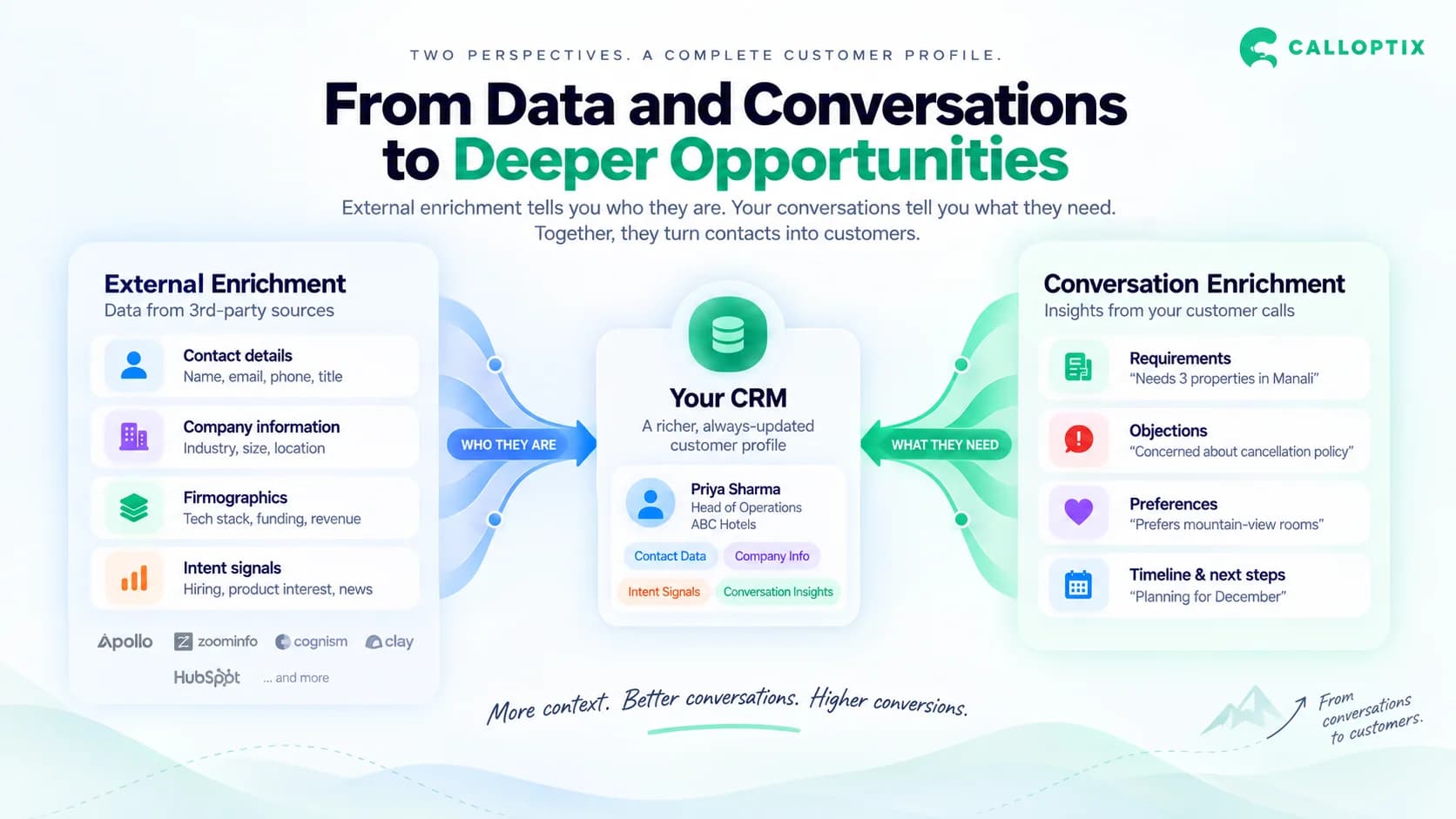
This is the distinction that matters for CallOptix.
CallOptix is not a replacement for Clay, Apollo, ZoomInfo, Cognism, or HubSpot when the job is finding a net-new prospect's email address or direct dial.
It sits on the other side of the first real conversation.
CallOptix can connect to existing VoIP systems, analyze calls, extract structured fields, generate tasks, and push enriched data into CRM records. Its current integration layer supports custom field mapping and automatic updates to contact records, while its contact and deal layer can retain communication history and preferences. Call Optix
That means a call does not have to remain an unstructured event.
For a call-heavy SMB that already has usable contact data, this distinction matters commercially too: the next investment does not always need to be another external data source. In some cases, the bigger gap is operationalizing the first-party context the team is already creating on calls.
It can become structured CRM data:
What the buyer says | What can become structured data |
|---|---|
“We need this live before Q4.” | Implementation timeline |
“Salesforce is non-negotiable.” | Required integration |
“Your competitor is cheaper.” | Competitor + price objection |
“I care more about QA than forecasting.” | Priority / preference |
“Send the security documentation first.” | Follow-up task |
“Call me next Wednesday afternoon.” | Preferred follow-up timing |
“Finance signs off after the demo.” | Decision process |
CallOptix's public integration workflow explicitly describes transcription, analysis, scoring, field extraction, task generation, and CRM field population after calls. Call Optix
For call-heavy teams, that changes the long-term value of the CRM.
Instead of relying only on periodic third-party refreshes, the contact record can also become more useful after every real conversation.
The better model is not “contact enrichment vs CallOptix”
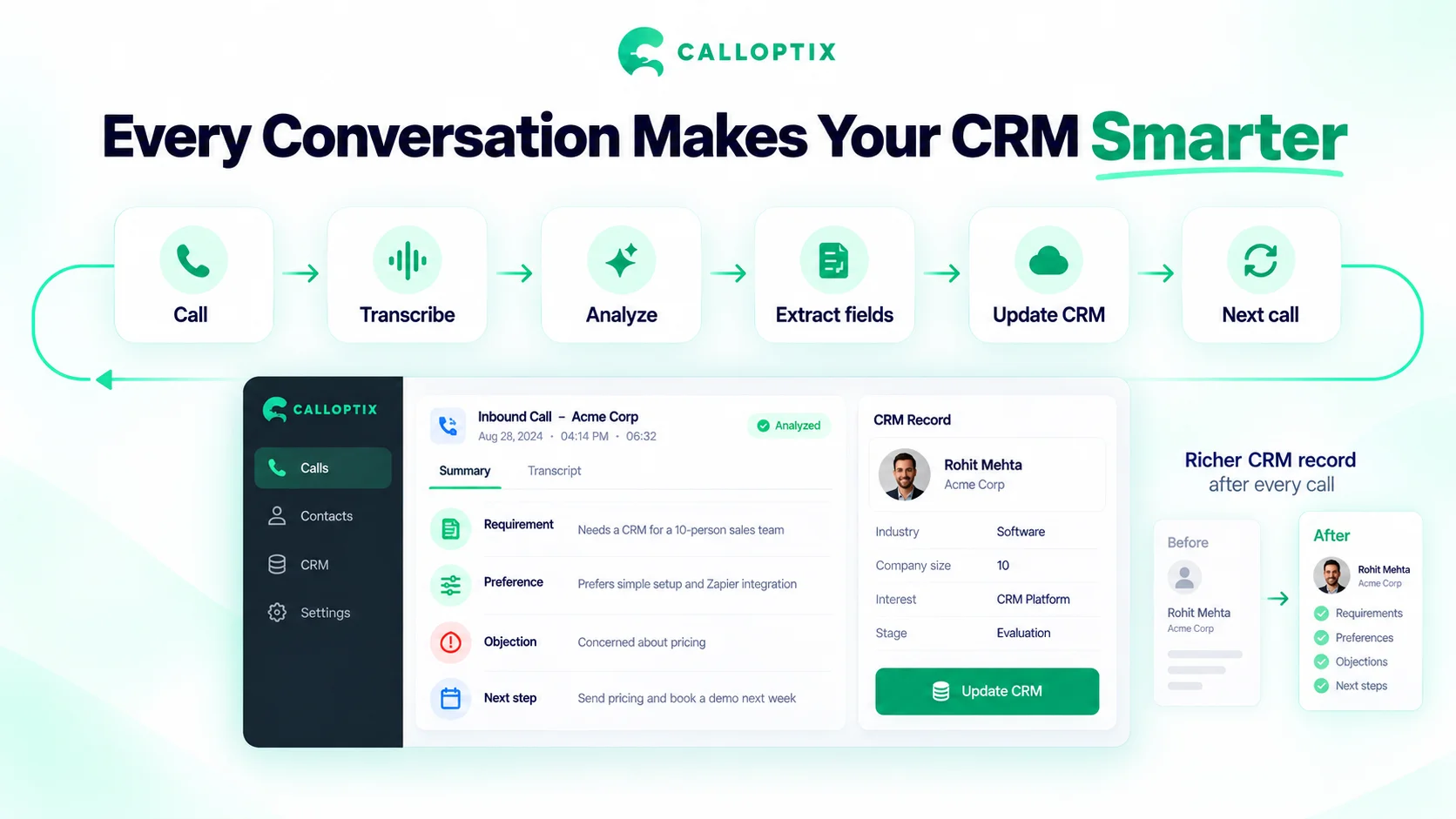
It is a lifecycle.
Before the first call: enrich from the outside
Use traditional enrichment and intent tools to answer:
- Who is the right person?
- What company do they work for?
- Can we reach them?
- Are they a fit?
- Is there a reason to prioritize them now?
This is where Clay, Apollo, ZoomInfo, Cognism, and HubSpot are strongest.
After the first call: enrich from the relationship
Now the questions change:
- What did this buyer actually need?
- What mattered most to them?
- Which objections came up?
- Who else is involved?
- What did they commit to?
- What did we commit to?
- What should the next rep know before calling?
This is where conversation intelligence becomes an enrichment source.
After every subsequent call: compound the context
The value compounds because preferences, objections, stakeholders, timelines, and commitments change over time.
A third-party provider may correctly tell you that Jane is still VP Sales at Acme.
Your own calls may tell you that Jane has already evaluated two competitors, needs a Salesforce integration, is waiting for security approval, and asked to reconnect after the 18th.
For the next sales conversation, the second set of facts may be more important.
Your CRM should know more about a buyer after every conversation, not just after every database refresh.
Which enrichment stack should you choose?
Do not begin with “Which vendor has the most data?”
Begin with the information gap your reps are trying to solve.
If your main problem is… | Start with… |
|---|---|
“We cannot find enough valid emails or phone numbers.” | Apollo, Cognism, or another contact-data provider |
“One provider misses too many records.” | Clay and a multi-provider waterfall |
“We need broader enterprise account intelligence.” | ZoomInfo |
“We already run our sales process inside HubSpot.” | HubSpot Data Enrichment |
“We know the contacts, but not which accounts are worth calling now.” | Intent and signal data |
“We already spoke to the buyer, but the next rep still has to research the history.” | Conversation enrichment with CallOptix |
“Our reps need both external context and first-party call context.” | Traditional enrichment + intent + CallOptix |
For many SMB and mid-market sales teams, the final row is where the stack eventually lands.
The first generation of enrichment tools reduced the time reps spent finding contact information.
The next generation needs to reduce the time reps spend reconstructing context.
A practical 14-day test before buying an enrichment tool
Do not evaluate these platforms using only a vendor demo.
Take 100 to 500 contacts that look like your real target market and run a controlled test.
Measure:
- 1Match rateWhat percentage of your records were enriched at all?
- 2Field accuracyManually verify a sample of titles, companies, emails, and phone numbers.
- 3Usable phone coverageFor call-heavy teams, a populated phone field is not enough. Track whether numbers actually connect to the intended person.
- 4FreshnessInclude known job changers and recently updated accounts. See whether the platform catches them.
- 5Intent usefulnessIf the product includes signals, ask whether the signal gives a rep a credible reason to prioritize outreach—not merely another dashboard badge.
- 6CRM behaviorTest exactly what gets created, overwritten, preserved, or updated. The best enrichment tool is a liability if it pollutes trusted CRM fields.
- 7Rep time savedGive reps enriched records and measure whether pre-call research time actually drops.
- 8Post-call continuityAfter the rep completes a call, check whether the information learned in that conversation becomes usable context for the next interaction.
That last test is especially important.
A sales-data stack should not only know more before a call. It should also know more because the call happened.
Frequently asked questions
What is the best contact enrichment tool for B2B sales?
There is no universal winner.
Clay is a strong choice for multi-source enrichment and custom research. Apollo is a practical all-in-one option for SMB and mid-market sales teams. ZoomInfo fits broader enterprise GTM intelligence requirements. Cognism is particularly relevant for EMEA and phone-heavy prospecting. HubSpot is a natural first choice when enrichment needs to live natively inside HubSpot CRM.
Test any provider against your own ICP before committing.
What is contact enrichment?
Contact enrichment is the process of adding useful information to an existing person or account record.
Traditional fields include business email, phone number, job title, employer, location, company size, industry, revenue, and technology usage.
Modern sales teams increasingly layer enrichment with intent signals and first-party interaction context.
What is the difference between contact enrichment and intent data?
Contact enrichment primarily helps answer who the person is and whether the account fits.
Intent data helps answer why now may be a better time to engage.
Examples include website visits, research activity, funding events, leadership changes, hiring activity, or job changes.
They solve different questions and are often more useful together.
What is conversation enrichment?
Conversation enrichment is the process of turning information learned during calls or other customer conversations into structured, reusable customer context.
That can include requirements, preferences, objections, competitors, budget, timeline, decision process, commitments, and next steps.
For call-heavy teams, conversation enrichment becomes increasingly valuable after the first interaction because it captures information specific to the relationship—not just information available from external sources.
Does CallOptix replace Apollo, ZoomInfo, Clay, Cognism, or HubSpot enrichment?
No—not when the requirement is net-new contact discovery or third-party company data.
CallOptix is complementary.
Traditional enrichment helps prepare the first call. CallOptix can analyze the conversations that follow, extract structured information, update CRM records, create tasks, and carry first-party context into the next interaction. Call Optix
Can enrichment eliminate manual pre-call research?
It can reduce it significantly, but only if the stack covers the information the rep actually needs.
A CRM can be fully populated with firmographic fields and still force manual research if it is missing current intent, previous conversation context, objections, preferences, or agreed next steps.
The useful target is not “a CRM with more fields.”
It is a rep who can open the record and understand who they are calling, why now, and what matters before they dial.
Final takeaway: the best contact record is one that keeps learning
Contact enrichment is still essential.
Sales teams need accurate emails, phone numbers, titles, firmographics, and company information. Intent signals can add the timing layer that traditional enrichment lacks.
But once your team starts speaking to the buyer, the most valuable new data may come directly from those conversations.
That gives sales teams a more complete model:
Contact data: Who should we talk to?Company data: Is this account a fit?Intent data: Who should we talk to now?Conversation data: What should we talk to them about?
The first three help you prepare for outreach.
The fourth helps every future interaction become more relevant.
For call-heavy B2B sales teams, that is the long-term gap worth solving.
Use an enrichment platform to keep external data current. Use intent to prioritize. Then make sure the requirements, objections, preferences, commitments, and next steps buyers give you on calls become part of the CRM instead of disappearing into recordings and notes.
Your CRM should not merely be enriched before the call. It should be enriched by the call.
Related Articles
Get the Latest Insights
Get the latest insights on call center optimization and AI-powered sales strategies delivered to your inbox.
By subscribing you agree to receive marketing emails. Unsubscribe anytime.