
What Is AI Call Scoring? How It Works, Examples and Best Practices
AI call scoring turns conversations into reviewable scorecards. Learn how automated scoring works, how to calibrate accuracy, and where human judgment still matters.
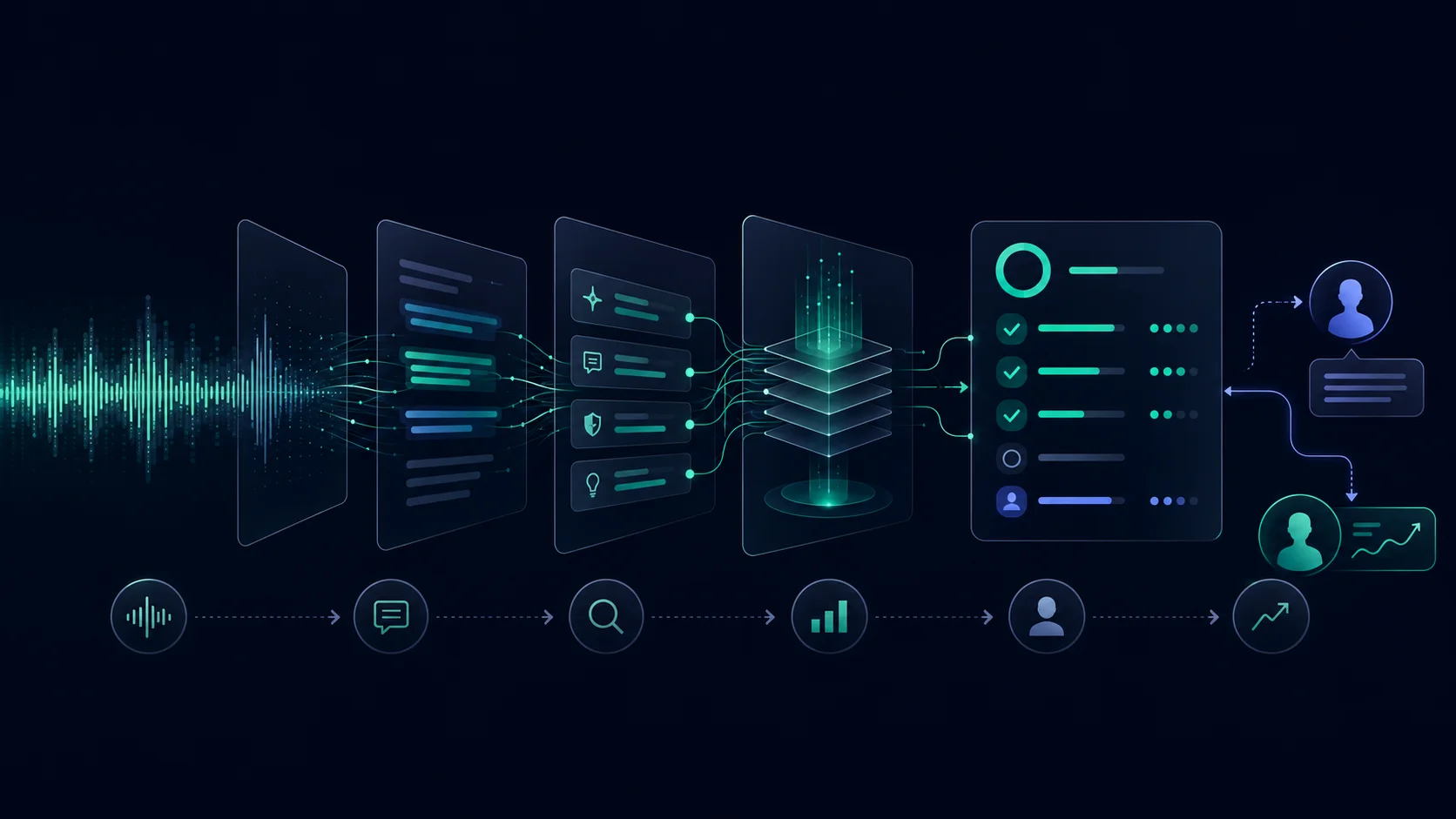
AI call scoring is the automated evaluation of a sales or customer-service conversation against an explicit scorecard. It converts a recording into a transcript, separates the speakers, checks the conversation for defined behaviours or outcomes, applies weights, and produces a reviewable score with supporting evidence.
The important word is reviewable.
A useful AI call score should show what was evaluated, what evidence was found, how the result was calculated and which items require human review. A bare “82/100” tells a manager almost nothing.
The short version
AI call scoring works best when:
- The scorecard contains objective, observable behaviours.
- Every result points back to transcript evidence.
- Low-confidence items go to a human reviewer.
- “Not applicable” is different from “failed.”
- Managers calibrate AI scores against independently reviewed calls.
- Scores direct coaching instead of acting as unquestionable verdicts about employees.
A system may score every eligible interaction, but 100% scoring coverage does not mean 100% scoring accuracy.
That distinction is where most implementations succeed or fail.
What is AI call scoring?
AI call scoring uses artificial intelligence to evaluate recorded or transcribed conversations against criteria selected by the business.
A sales scorecard might ask:
- Did the representative establish an agenda?
- Did they uncover the prospect’s current process?
- Did they ask about decision criteria or timeline?
- Did they connect the proposed solution to a stated problem?
- Did both sides agree on a specific next step?
A support scorecard might instead ask:
- Did the agent verify the customer correctly?
- Did they identify the reason for contact?
- Was the approved process followed?
- Was the outcome explained clearly?
- Did the agent confirm resolution before closing?
The scoring technology may be the same, but the definition of a successful conversation is different.
Current systems generally combine transcription, a manager-defined evaluation form and automated criterion-level assessments. Aircall describes the resulting score as an aggregation of individual, reviewable questions rather than one opaque number. Aircall’s AI call-scoring explanation
What AI call scoring is—and what it is not
Capability | What it answers | AI call scoring? |
|---|---|---|
Transcription | What words were spoken? | No |
Speaker diarization | Who spoke each word? | No, but it is an input |
Sentiment analysis | What emotional signal might be present? | No |
Call summary | What happened during the conversation? | No |
Keyword detection | Was a word or phrase mentioned? | One possible component |
AI call scoring | How did the call perform against an explicit rubric? | Yes |
Agent performance scorecard | How is a person trending across multiple calls and outcomes? | Broader than one call score |
Coaching workflow | What behaviour should improve next? | The operational use of scoring |
A transcript is evidence. A summary is a compressed description. A score is an evaluation against a standard.
Confusing these outputs leads to weak implementations—for example, asking a summarisation model to produce an arbitrary quality rating without giving it a defined scorecard.
How automated call scoring works
1. Capture and prepare the audio
The process starts with a recorded call or audio stream. Audio quality, channel separation, background noise and overlapping speech can affect every downstream result.
When each participant is recorded on a separate channel, the system can attribute speech directly. For mixed audio, speaker diarization identifies changes and assigns speaker labels to words. Deepgram’s speaker-diarization documentation
2. Convert speech into structured evidence
Speech-to-text can produce:
- The transcript
- Word and utterance timestamps
- Speaker labels
- Confidence information
- Detected language, where applicable
Confidence is not the call-quality score. It indicates how certain the transcription system is about the words it recognised.
Deepgram, for example, exposes word-level confidence separately from overall transcript confidence and recommends testing thresholds on the organisation’s own audio rather than blindly adopting a universal cutoff. Deepgram’s confidence documentation
This matters because a low-confidence transcription of a price, date, product name or required statement should not silently become a definite scoring failure.
3. Apply the scorecard
The system evaluates each criterion separately. A well-defined criterion contains:
- A precise question
- Applicable call types
- Allowed answers
- Scoring weight
- Evidence requirements
- Not-applicable rules
- Escalation conditions
- Examples of passing and failing behaviour
Weak criterion: “Was the representative professional?”
Stronger criterion: “Did the representative introduce themselves and the company before asking the first discovery question?”
The first depends on an undefined opinion. The second can be checked against observable evidence.
Genesys similarly recommends objective, transcript-driven questions, consistent terminology and one condition per question. Its documentation warns against asking AI to infer subjective qualities that are not directly observable in the transcript. Genesys AI-scoring best practices
4. Calculate the score
A basic weighted score can be calculated as:
Total score = [sum of (criterion weight × criterion result) ÷ sum of applicable weights] × 100
A criterion result might use 0 for fail, 0.5 for partial and 1 for pass.
If a criterion is genuinely not applicable, remove its weight from the denominator. Do not treat “not applicable” as a failure.
Critical requirements can also be handled as separate gates. For example, a missing mandatory statement might create a review flag regardless of the weighted total. Whether a statement satisfies a legal obligation should still be reviewed under the organisation’s compliance policy.
5. Attach evidence
Each score should include:
- The relevant transcript excerpt
- Speaker
- Timestamp
- Reason for the result
- Evaluation confidence
- Whether the item was automatically accepted or sent for review
Evidence makes the score useful in coaching and disputable when it is wrong.
6. Route exceptions to humans
Not every result deserves the same automation. A practical workflow can contain three routes:
Route | Appropriate use |
|---|---|
Automatically accepted | Clear evidence, objective criterion and sufficient confidence |
Human review | Ambiguous evidence, low transcript confidence or consequential criterion |
Not scored | Missing audio, unsupported language, corrupted recording or insufficient evidence |
The AI should reduce the number of calls a manager must inspect—not remove the manager’s ability to inspect them.
Annotated AI call-score example
The following is an illustrative composite, not a Call Optix customer call.
Scenario: A representative conducts a 12-minute B2B discovery call.
Criterion | Weight | Result | Evidence | Contribution |
|---|---|---|---|---|
Established purpose and agenda | 10 | Pass | Agenda stated at 00:18 | 10 |
Explored current process and impact | 15 | Partial | Asked about current tool but not operational impact | 7.5 |
Identified decision process or timeline | 10 | Pass | Timeline and decision-maker discussed at 04:05 | 10 |
Connected solution to stated problem | 15 | Partial | Relevant feature mentioned without an explicit connection | 7.5 |
Acknowledged and answered objection | 10 | Pass | Objection restated before response at 10:13 | 10 |
Confirmed next step with owner and date | 15 | Fail | “I’ll send the details” with no owner, date or meeting | 0 |
Delivered required approved statement | 15 | Pass | Statement found in transcript | 15 |
Summarised conversation accurately | 10 | Partial | Recap omitted prospect timeline | 5 |
Total | 100 | 65/100 |
The useful conclusion is not “this is a 65-point representative.”
The useful conclusion is: The call lost most of its score because discovery was incomplete and no dated next step was established. Review those two moments before the next coaching session.
That diagnosis gives the manager something specific to inspect and the representative something specific to practise.
What AI can score reliably—and what still needs judgment
Criterion type | Automation fit | Example |
|---|---|---|
Exact words or disclosures | Strong | Was the approved statement present? |
Observable questions | Strong | Did the agent ask about the timeline? |
Structured facts | Strong | Were dates, budget or requirements captured? |
Explicit next steps | Strong | Was an owner and date confirmed? |
Conversation sequence | Conditional | Did discovery happen before the pitch? |
Discovery depth | Conditional | Did questions uncover impact, not merely the current setup? |
Objection handling | Conditional | Was the objection acknowledged and answered with relevant information? |
Summary accuracy | Conditional | Did the closing recap reflect the conversation? |
Warmth, rapport or empathy | Human-led | Did the interaction feel genuinely empathetic? |
Sarcasm or cultural nuance | Human-led | Was apparently positive wording actually sarcastic? |
Legal sufficiency | Expert review | Did the interaction satisfy the applicable obligation? |
Employment consequences | Human decision | Should the result affect formal performance action? |
The more subjective or consequential the criterion, the more important review and appeal become.
How to design an effective AI call scorecard
Start with the business decision
Do not begin by asking, “What can the AI detect?” Begin with:
- What outcome are we trying to improve?
- Which observable behaviours are plausibly connected to it?
- What action will we take when the score changes?
A criterion that never affects coaching, routing, compliance review or process improvement probably does not belong in the first scorecard.
Score behaviours, not personalities
Prefer observable behaviours such as confirming the customer’s desired outcome, asking a follow-up question after an objection, or agreeing on a dated next step.
Avoid criteria such as “was confident,” “had a good attitude,” “sounded intelligent,” or “was persuasive.” Behavioural questions are easier to explain, contest and improve.
Keep each criterion atomic
Do not ask whether the representative introduced themselves, confirmed the customer’s details and explained the purpose of the call in one combined item. The representative might complete two of the three actions. Split it into three criteria.
Separate transcript evidence from system data
Some questions can be answered from the conversation: Was a callback promised? Was a date mentioned? Did the representative summarise the issue?
Others require metadata or connected systems: Did the callback actually happen? Was the CRM updated? Was the task completed on time?
Do not ask a transcript-only evaluator to judge an action that happened after the call. Genesys explicitly documents this distinction for its own AI scoring: the model evaluates the transcript and evaluation form, not unrelated routing or platform metadata. Genesys AI-scoring scope
A broader performance platform can combine call scores with task completion, outcomes and activity metrics—but those should remain traceable to their respective data sources.
Make not applicable explicit
A call without an objection should not fail an objection-handling question. Define applicability rules by conversation type, duration and whether the relevant event occurred.
Preserve the evidence
For every criterion, retain the result, evidence span, explanation, confidence, model or scorecard version, and any human override.
How to calibrate AI call scoring
Before using scores operationally, compare the AI with trained human evaluators.
A practical calibration process
- 1Select a varied set of calls across agents, outcomes, lengths and conversation types.
- 2Have two people evaluate the calls independently.
- 3Resolve disagreements and create a reference answer.
- 4Run the AI against the same calls.
- 5Compare agreement for each criterion—not only the total score.
- 6Examine false passes and false failures separately.
- 7Rewrite ambiguous criteria.
- 8Set thresholds for automatic acceptance and human review.
- 9Repeat the test after meaningful model, language or scorecard changes.
Genesys recommends establishing agreement through systematic testing and using at least 25 interactions as an initial validation set for its implementation. Treat that as a starting point, not a universal guarantee; a multilingual or highly varied call population may require a larger set. Genesys calibration guidance
Track:
- Criterion-level agreement
- False-pass rate
- False-fail rate
- Percentage routed to review
- Human override rate
- Differences by language, team and call type
- Changes after scorecard revisions
NIST’s AI Risk Management Framework recommends maintaining audit histories, documenting human oversight, and tracking overrides, reported errors and adjudication activity. Those practices translate directly to trustworthy call scoring. NIST AI RMF Measure playbook
The three-layer model for trustworthy call scoring
1. Coverage layer
Apply the correct scorecard consistently to every eligible call. This reveals patterns that random manual selection can miss.
2. Review layer
Route calls based on confidence, consequences and exceptions. Managers should see low-confidence evaluations, critical failures, unusual outliers, disputed scores and calls connected to meaningful outcomes.
3. Coaching layer
Turn patterns into behaviour change. The score selects the evidence. The manager supplies context. Coaching changes the behaviour.
AI call-scoring examples by team
Team | Useful criteria |
|---|---|
B2B sales | Discovery depth, qualification, problem-to-solution connection, objection handling, dated next step |
Customer support | Verification, reason identification, process adherence, resolution, escalation and closing recap |
Hospitality reservations | Dates and occupancy, guest requirements, room recommendation, rate explanation, policy communication and follow-up |
Real estate | Location, budget, property requirements, decision timeline, objections and viewing commitment |
Admissions or recruitment | Eligibility questions, programme or role fit, documentation, concerns and next action |
Each conversation type should have its own scorecard or applicability rules. A cancellation call should not be marked as a failed booking call simply because it did not produce a reservation.
How managers should use AI scores
The best workflow is not “open the leaderboard and confront the lowest score.” Instead:
- 1Review team-level trends.
- 2Identify the criterion that changed.
- 3Open the calls contributing to that change.
- 4Verify the evidence.
- 5Select one coachable behaviour.
- 6Agree on what the improved behaviour sounds like.
- 7Recheck the same criterion after the next set of calls.
- 8Update the scorecard if repeated overrides reveal a design problem.
If you want to establish a manual baseline before automating this process, use the Call Optix Sales Call Audit Guide. It explains how to select and review five calls without listening to every recording.
What to look for in AI call-scoring software
Before choosing a platform, ask whether it provides:
- Custom criteria, weights and thresholds
- Separate scorecards by conversation type
- Pass, partial, fail and not-applicable handling
- Criterion-level evidence and timestamps
- Transcript and recording access
- Low-confidence and exception queues
- Human overrides with reason codes
- Scorecard version history
- Trends by representative, team and criterion
- Connection to outcomes, tasks or CRM activity
- Role-based access and dispute workflows
- Exportable data for independent validation
Call Optix’s Performance Intelligence brings configurable call-quality scoring together with trends, team comparisons, task completion and calls selected for coaching. Its Coaching and Enablement layer is designed to convert those signals into specific development workflows.
Frequently asked questions
What is AI call scoring?
AI call scoring is the automated evaluation of a recorded or transcribed conversation against a defined scorecard. It checks criterion-level evidence, applies weights and returns a reviewable result that managers can use for quality assurance, coaching or process improvement.
How is AI call scoring different from sentiment analysis?
Sentiment analysis estimates an emotional signal such as positive, neutral or negative. AI call scoring evaluates whether a conversation satisfied specific business criteria. Sentiment may be one input, but it is not a substitute for a scorecard.
Can AI score 100% of calls?
AI can evaluate every eligible call for which the system has usable audio, an appropriate scorecard and supported processing. Calls with missing audio, poor transcripts, unsupported languages or ambiguous evidence should be flagged, excluded or routed for human review.
How accurate is automated call scoring?
Accuracy depends on audio quality, transcription, speaker attribution, scorecard clarity and the type of criterion. Objective transcript-based questions are generally easier to automate than subjective judgments. Accuracy should be measured per criterion against independently reviewed calls.
What criteria should a sales-call scorecard contain?
A sales scorecard can include agenda setting, discovery depth, qualification, connection between the problem and proposed solution, objection handling, accurate recap and confirmation of a specific next step. The criteria should reflect the organisation’s sales process rather than a generic universal script.
Should managers use AI scores for employee decisions?
AI scores should not be treated as unquestionable evidence for consequential employee decisions. Managers should verify the underlying call, consider context, allow disputes and document overrides—especially when a score could affect compensation, discipline or employment.
How should a small team start using AI call scoring?
Begin with one conversation type and a small scorecard based on observable behaviours. Manually review a varied calibration set, compare AI and human results, rewrite ambiguous criteria and initially route low-confidence or high-impact items to a manager.
Turn one call into a reviewable scorecard
Stop choosing recordings at random. Run one real conversation through Call Optix’s free call analysis to see how call data can be transformed into structured insights and coaching-ready evidence.
Related Articles
Get the Latest Insights
Get the latest insights on call center optimization and AI-powered sales strategies delivered to your inbox.
By subscribing you agree to receive marketing emails. Unsubscribe anytime.