
9 Customer Service Problems AI Speech Analytics Can Find and Fix
Customers calling back, QA blind spots, rising escalations or slow wrap-up? See nine customer-service problems AI speech analytics can diagnose and fix.
If customers keep calling back about the same issue, supervisors hear about an escalation only after it has gone badly, or QA scores are moving while nobody can explain why, you probably do not have a data shortage.
You have an unstructured data problem.
The explanation is often sitting inside thousands of customer conversations that nobody has time to listen to.
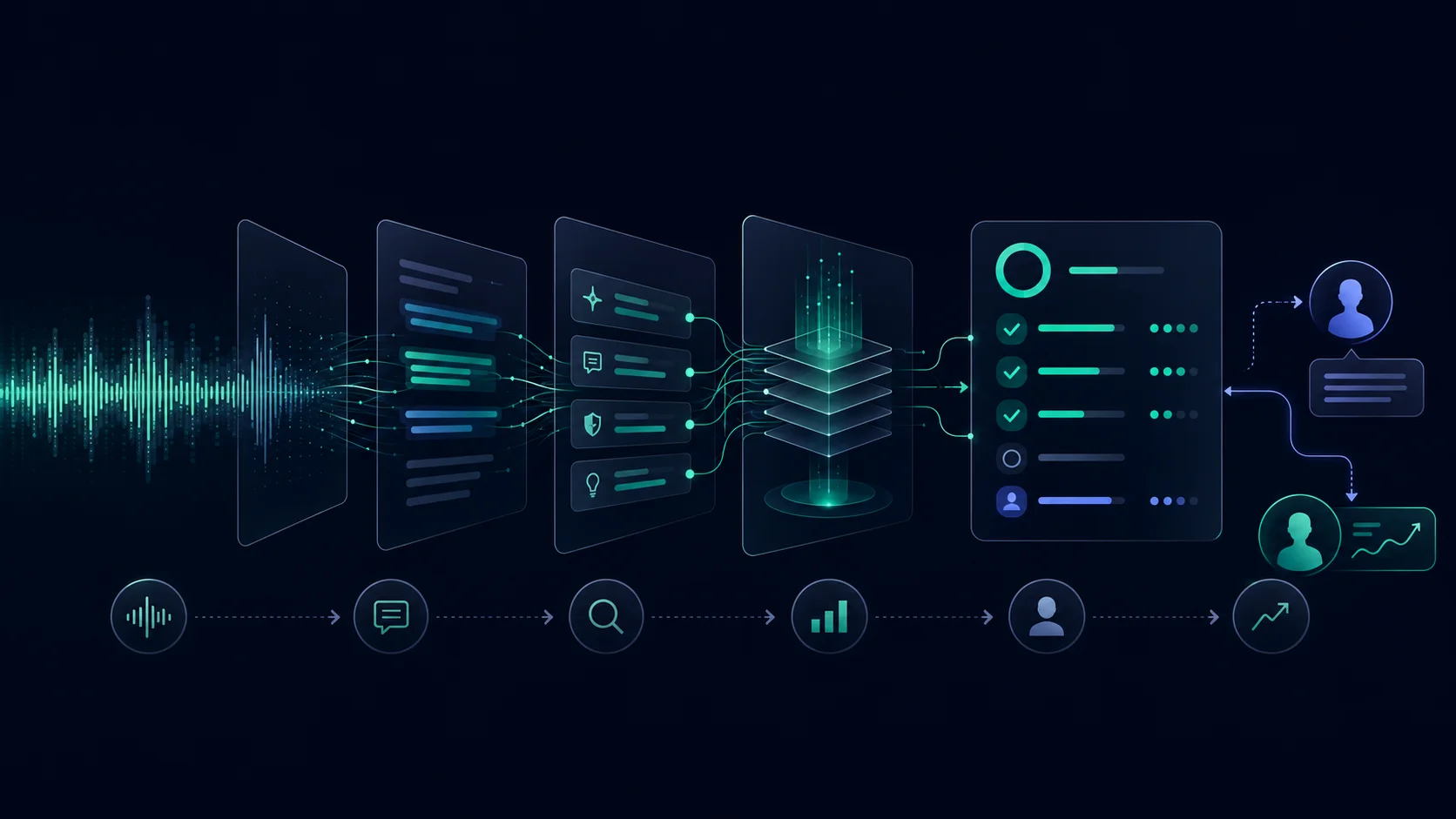
AI speech analytics turns customer-service calls into searchable, structured data. It typically starts with speech-to-text, then analyzes the conversation for things such as contact reason, resolution, repeated issues, required behaviors, customer language, agent actions and broader patterns across calls.
The useful question is no longer:
"What happened on this call?"
It becomes:
"Why does this keep happening across our calls, and what should we fix?"
That distinction matters.
Speech analytics is most valuable when it helps a support team diagnose an operational problem, find the conversations behind it and decide what to change.
The symptom checklist
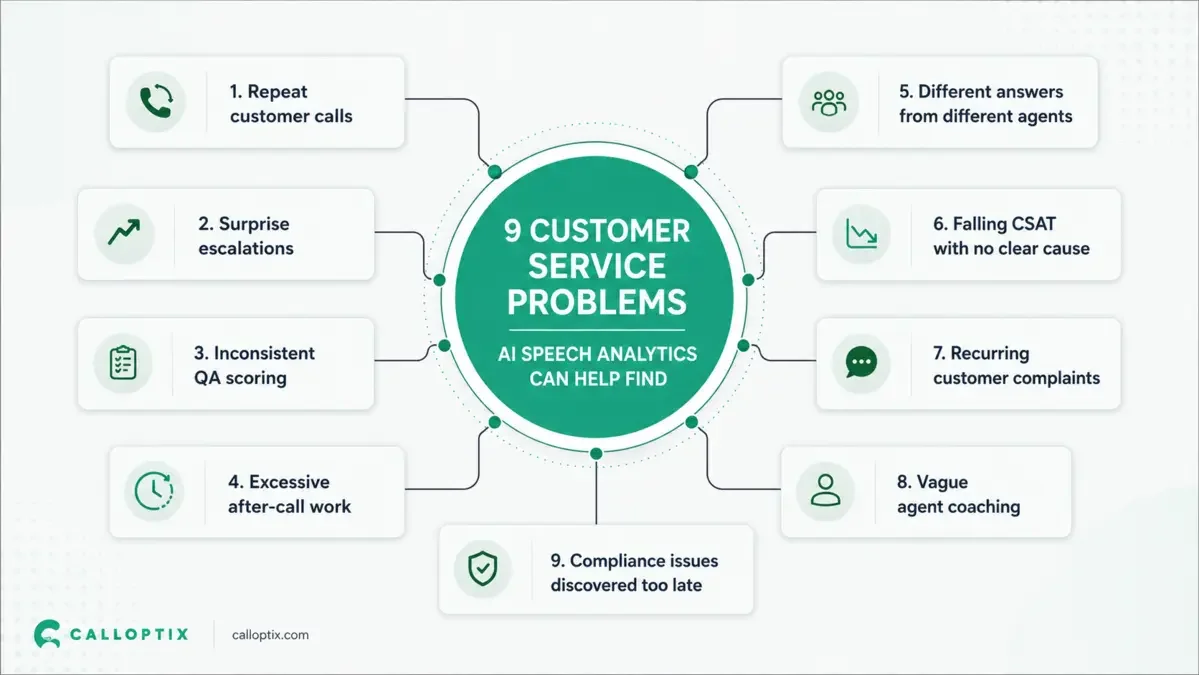
If any of these sound familiar, your call recordings may already contain the answer:
- 1
- 2
- 3
- 4
- 5
- 6
- 7
- 8
- 9
These are nine practical customer-service use cases for AI speech analytics.
Several of them share causes, and we have flagged those overlaps where they occur, because the fix is usually cheaper when you solve the shared cause once instead of nine times.
The important part is not the AI. It is what you do after the pattern becomes visible.
1. Why do customers keep calling back about the same issue?
Short answer: Repeat calls usually mean the first interaction did not create a durable resolution, but the reason may be an agent problem, a process problem, a policy problem or something outside the contact center entirely.
First Contact Resolution, or FCR, measures whether a customer's issue is resolved during the first interaction without another contact, escalation or callback. It matters because unresolved issues generate additional customer effort and additional contact volume.
But a low FCR number alone does not tell you what went wrong.
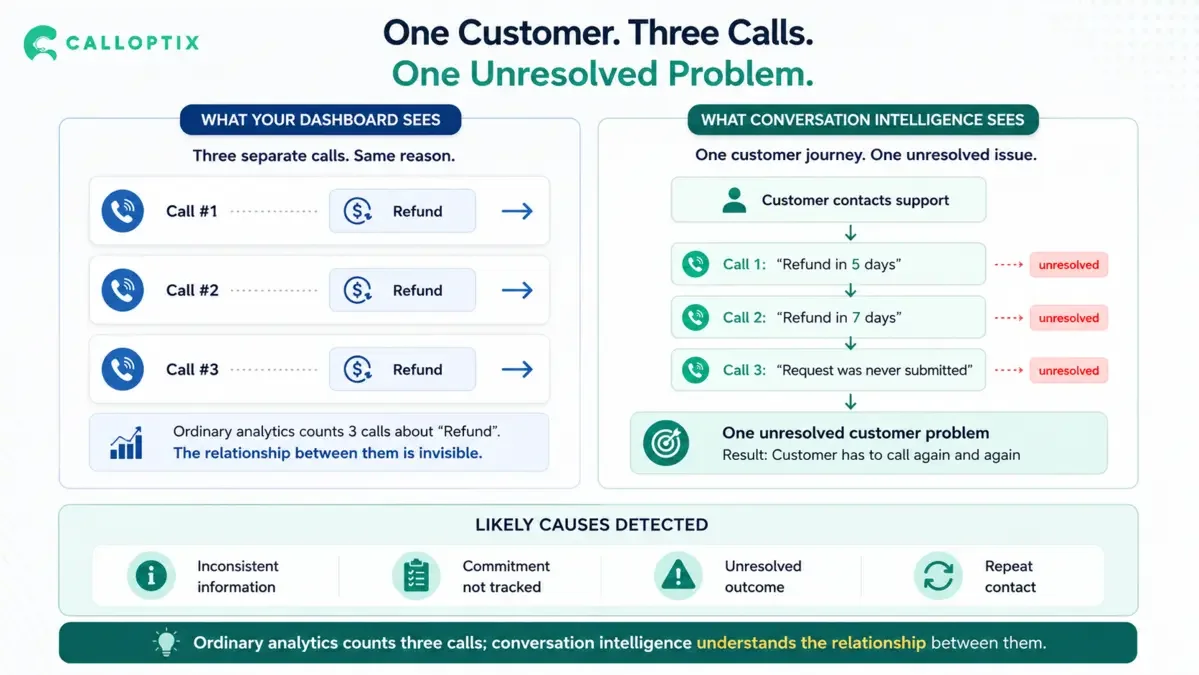
Imagine a customer contacts support three times about the same refund. Call one says the refund will arrive within five days. Call two says seven days. Call three says the original request was never submitted.
The dashboard sees three calls.
Speech analytics can help reveal that they were actually one unresolved problem spread across three conversations.
What speech analytics should look for
For repeat contacts, useful signals include:
- the customer's reason for calling
- whether the issue was marked resolved
- promises or commitments made by the agent
- transfers and callbacks
- the same customer returning within a defined period
- whether the reason for the second call matches the first
- conflicting information across conversations
- recurring product, policy or process failures
Commitments are worth calling out specifically. In CallOptix's own analysis of more than 10,000 recorded calls, roughly 40% of the specific follow-up commitments made during a conversation were never fulfilled. That analysis was run on B2B sales calls rather than support queues, so treat the exact figure as directional. But the mechanism is identical in support: a promise made on the call ("I'll email you the confirmation Friday") often exists nowhere except the audio, so nobody tracks whether it happened, and the customer calls back on Monday.
This makes it possible to move from:
"Our repeat-call rate increased."
to:
"Refund-status calls are repeating because customers receive different processing-time estimates and some cases leave the first call without a confirmed next step."
That second statement is something an operations team can fix.
What to fix
Start by defining what "resolved" means for each major contact reason.
Then group repeat contacts into causes:
Agent gap: The correct process existed but was not followed.
Knowledge gap: The agent could not find the correct answer.
Authority gap: The agent understood the problem but lacked permission to solve it.
Process gap: The support workflow itself created another contact.
Product or service gap: The actual underlying problem kept recurring.
Customer behavior: The issue was answered correctly, but the customer contacted again looking for a different outcome.
That last category matters. Agents commonly describe customers repeatedly calling about the same policy until someone gives a different answer. That is a consistency problem, and it is really problem 5 below showing up as a repeat call. It is not necessarily an FCR failure caused by the original agent.
Do not optimize FCR in isolation. A team can sometimes increase FCR by simply keeping customers on calls longer, which may raise handle time without addressing the underlying process. FCR should be read alongside resolution quality, repeat contacts, transfers, customer effort and handle time.
2. Why do customer escalations keep catching supervisors by surprise?
Short answer: Escalations rarely begin with a customer suddenly becoming angry. They usually build through a sequence of friction that traditional call metrics do not show.
Consider what a dashboard might show:
- Call duration: 18 minutes
- One transfer
- Disposition: Billing
Now consider what actually happened:
The customer explained the problem twice.
The agent placed them on hold.
The customer was given the same answer they had already received on a previous call.
They asked what could actually be done.
The agent repeated the policy.
Then the customer asked for a supervisor.
The escalation is obvious when you read the conversation. It is almost invisible in the traditional metrics.
This is the operational tension agents describe constantly: customers becoming increasingly frustrated while the agent tries to obtain supervisor assistance, or while the customer repeats information that has already failed to resolve the problem twice.
What speech analytics should look for
An escalation model can combine signals such as:
- "I already called about this"
- repeated requests for a manager
- cancellation or complaint language
- multiple failed explanations
- repeated customer questions
- long holds
- multiple transfers
- interruptions or talk-over
- changes in conversational sentiment
- explicit statements of dissatisfaction
- unresolved outcomes
Looking for a combination is more useful than searching for one angry keyword. This is the practical difference between conversation intelligence and basic call analytics: one reads the sequence of events inside the call, the other counts the call.
What to fix
Once escalation patterns are visible, ask:
Which issues escalate most often?
At what point in the conversation does escalation usually begin?
Which policies leave agents with no workable option?
Which agents successfully resolve the same issue without escalation?
Are customers escalating because of agent behavior or because the agent has no authority to solve the problem?
That distinction prevents a common management mistake: coaching the agent when the actual problem is the process.
A warning about sentiment and emotion detection
Sentiment should be treated as a signal for investigation, not objective proof of how someone feels.
This is not a hypothetical caution. At the INTERSPEECH 2025 Speech Emotion Recognition in Naturalistic Conditions Challenge, a competitive system scored a macro F1 of roughly 40% on categorical emotion recognition in spontaneous speech. That is a competitive result on real, unscripted audio, not a weak baseline.
A 2025 review of speech emotion recognition in conversations points to why: much of the field's headline accuracy comes from acted datasets that do not capture real emotional variability, and there is limited cross-validation across languages and databases, which restricts how well models generalize. Add recording quality, culture, accent and overlapping emotional cues, and a confident "angry" label is doing more inference than it appears to.
Use sentiment to prioritize calls worth reviewing.
Do not use it as an unquestionable judgment about a customer or employee.
3. Why does QA feel random or unfair?
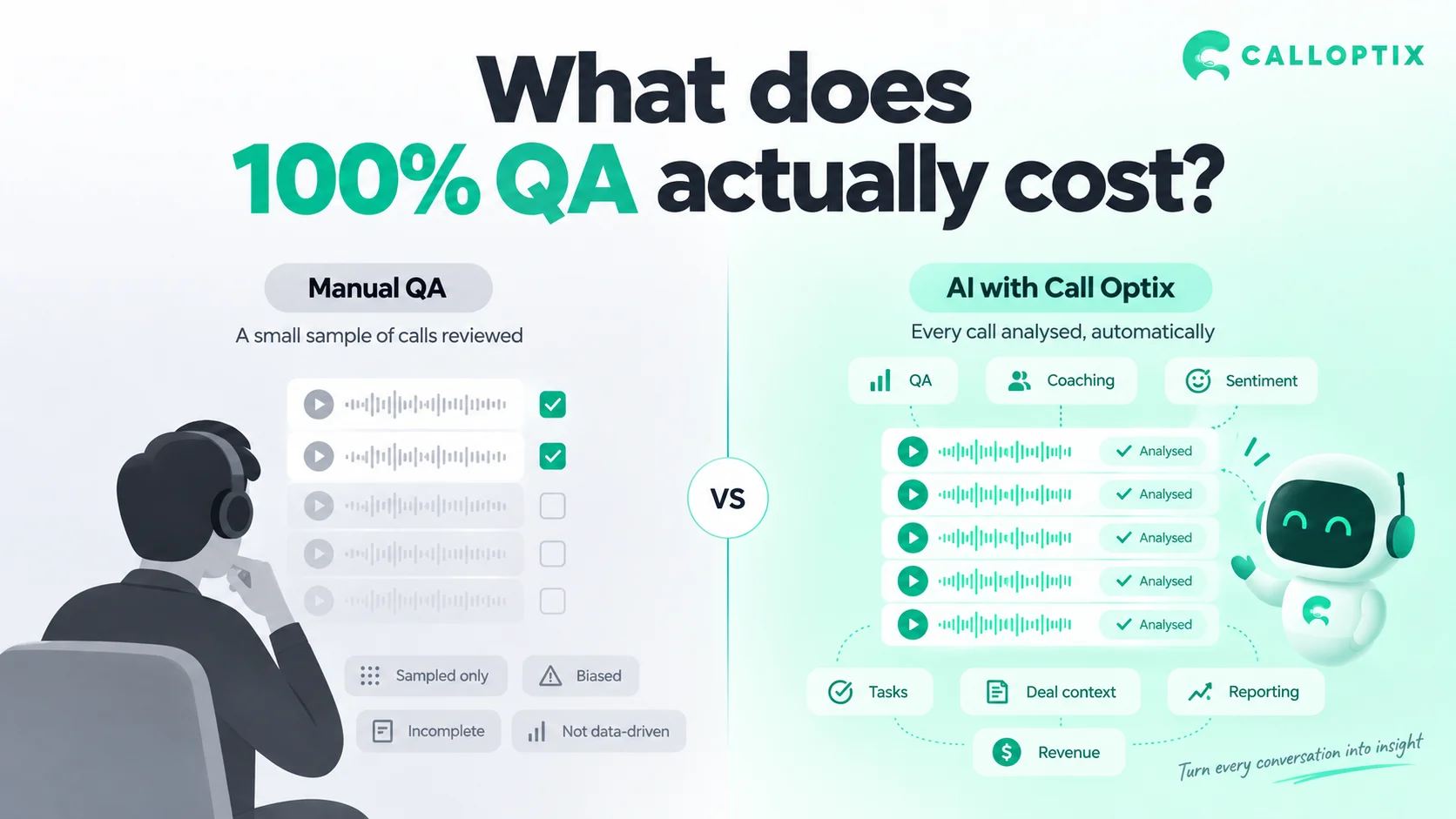
Short answer: If QA evaluates only a few calls from an agent who handles hundreds, one unusual interaction can disproportionately influence how that employee is judged.
This is a structural limitation of manual quality assurance.
Verint's contact-center QA guidance puts traditional manual sampling in the range of 1 to 3 percent of interactions, on the grounds that manual review at higher volumes is operationally impractical. The same guidance notes a second problem that matters more than the sample size: manual sampling skews toward the calls supervisors happen to notice, the easy ones and the escalated ones, while systemic patterns sit in the middle of the distribution where nobody is looking.
Agents notice this too. A Qualtrics study covered in this 2022 announcement found that 33% of customer service agents did not feel their performance was fairly evaluated, in an environment where a QA manager typically reviews three to five calls per agent per week.
That is the complaint you hear on the floor, stated as a number: a single selected call determines a quality score despite hundreds of other interactions in the same period, and the same behavior can be interpreted differently by different reviewers.
Speech analytics changes the role of QA by allowing automated evaluation across a much larger share of eligible interactions. The coverage gap is real and measurable: Verint documents Fiserv moving from evaluating 1% of calls manually to 96% with automated scoring.
But simply letting AI score more calls does not automatically create a fair QA program.
What a defensible AI QA program needs
A useful score should answer four questions:
- 1What exactly was evaluated?
- 2What evidence from the conversation supports the result?
- 3How was the score calculated?
- 4Which decisions still require human review?
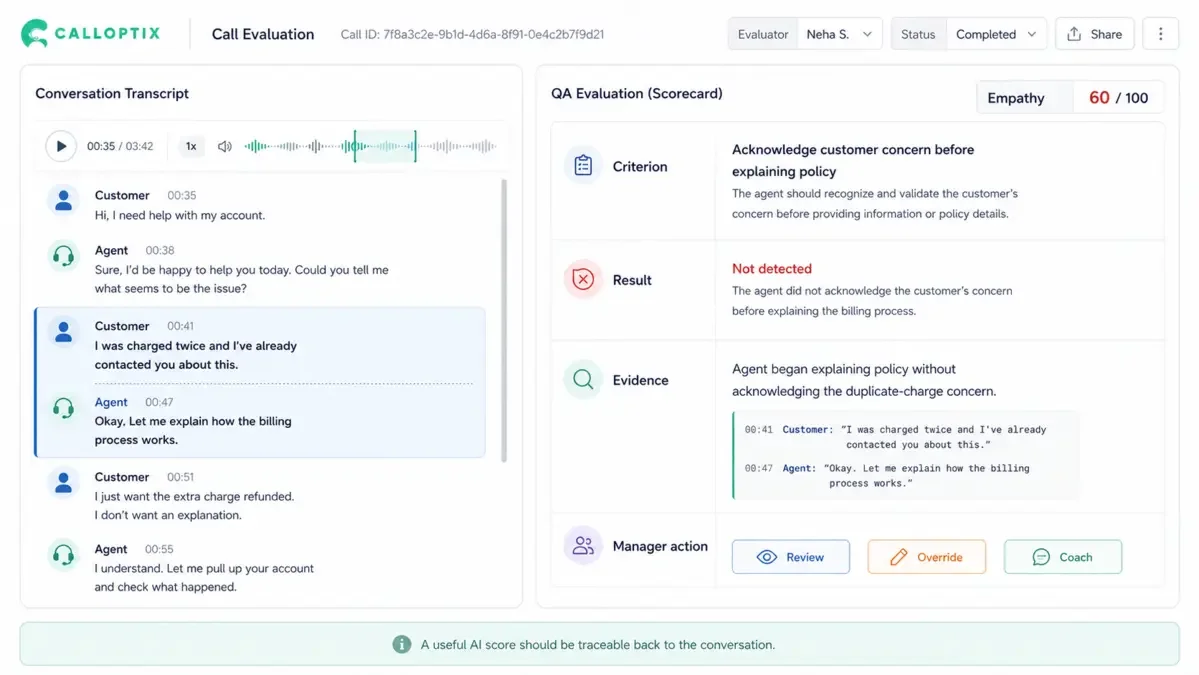
For example, instead of:
Empathy: 60/100
a useful evaluation might say:
Criterion: Agent acknowledges customer concern before explaining policy.
Result: Not detected.
Evidence: Customer describes being charged twice. Agent immediately begins explaining the billing process without acknowledging the inconvenience.
Now a supervisor can agree, disagree or coach against something concrete. We go deeper into how this evidence-to-score mechanism works in What Is AI Call Scoring.
What to fix
Before automating QA:
- make vague scorecard questions more explicit
- separate critical failures from coaching opportunities
- define acceptable evidence for each criterion
- calibrate AI scoring against human reviewers
- retain human override
- regularly review false positives and false negatives
- show agents the evidence behind scores
If your current scorecard is the vague kind, our 20-criterion scorecard template is a usable starting structure, including the weighting and machine-readable formats.
The objective should not be "replace QA analysts."
It should be:
Let machines perform repetitive evaluation so QA teams spend more time investigating exceptions, calibrating standards and coaching people.
4. Why are agents spending so much time writing notes after calls?
Short answer: Agents often repeat information after a conversation that already exists in the conversation itself.
After-call work can include:
- writing case notes
- summarizing what happened
- selecting a disposition
- updating CRM fields
- creating a follow-up
- recording a promise
- escalating a ticket
NiCE's contact-center glossary describes these exact activities as after-call work, or post-call processing: logging call details, sending follow-ups internally or to the customer, and scheduling any necessary follow-up actions.
The problem becomes obvious in high-volume queues. An agent finishes one difficult conversation and immediately has to convert a ten-minute discussion into a clean paragraph, pick the correct category, record the outcome and prepare for the next caller. Because ACW is a component of Average Handle Time, the same operation that requires detailed documentation is usually also measuring, and squeezing, the time available to write it. Agents describe being given seconds to complete notes while still being held to a documentation standard.
What speech analytics can automate
A modern system can turn the conversation into structured output such as:
Contact reason: Duplicate charge
Resolution: Refund requested
Customer action required: None
Agent action required: Confirm refund processing
Promised deadline: Friday
Disposition: Billing / Duplicate charge
Follow-up: Check refund status Friday
The useful part is not merely generating a paragraph.
It is generating the specific fields your operation actually needs.
What to fix
Do not start with:
"Generate a summary of this call."
Start with:
"What information does the next agent, CRM, QA reviewer and reporting system actually need after this call?"
Then automate those fields.
For higher-risk fields, use confidence thresholds or human review.
Measure the result using:
- after-call work time
- note completeness
- disposition accuracy
- reopened tickets
- missed follow-ups
- time spent correcting automated notes
Automation is successful only if it reduces work without making the record less trustworthy.
5. Why are customers getting different answers from different agents?
Short answer: Inconsistent service often hides until a customer contacts support more than once and notices the contradiction.
One agent says a return is eligible.
Another says it is not.
One says delivery takes three days.
Another says seven.
One promises a callback.
The next agent cannot find any record of it.
The problem may be training, but it may also be:
- ambiguous internal policy
- an outdated knowledge article
- agents working from different systems
- different permission levels
- undocumented exceptions
- unclear escalation rules
Speech analytics can compare conversations about the same contact reason and identify where explanations or outcomes diverge.
This is the same root cause behind a share of the repeat calls in problem 1. If you only have budget to fix one thing this quarter, fixing inconsistency usually moves both numbers.
What to look for
Take your top 20 reasons for contacting support.
For each reason, compare:
- how agents explain the policy
- what resolution is offered
- whether the customer is transferred
- whether an exception is offered
- whether the issue is marked resolved
- whether the customer contacts you again
This can uncover something ordinary dashboards will not.
You may discover that your team has not actually agreed on the answer.
What to fix
For each high-volume issue:
- 1Establish the correct resolution path.
- 2Document permitted exceptions.
- 3Make the approved explanation easy to find.
- 4Identify conversations where the answer differs.
- 5Coach the exception rather than the entire team.
- 6Update the underlying knowledge base if the ambiguity is systemic.
Consistency does not mean forcing every agent to sound identical.
It means the customer's outcome should not depend on which employee happens to answer the phone.
6. Why did CSAT fall when the rest of our dashboard looks normal?
Short answer: Most operational dashboards are better at telling you what changed than explaining why it changed.
Suppose:
- call volume is normal
- average handle time is normal
- abandonment is normal
- staffing is normal
But CSAT drops.
Where do you look?
Speech analytics lets you segment conversations around the outcome and ask more useful questions.
For example:
- Which contact reasons have become more negative?
- Did transfer rates increase for one issue?
- Are customers mentioning a new fee?
- Did a recent policy change create confusion?
- Are callers repeatedly saying they already contacted support?
- Did one queue begin generating more unresolved calls?
- Are longer holds concentrated around one process?
The goal is to connect an outcome metric to observable behavior inside the conversation.
What to fix
Do not begin by asking AI:
"Why is CSAT down?"
That invites an overly broad answer.
Ask narrower questions:
"Which contact reasons increased most among low-CSAT conversations?""What changed in billing-related conversations after August 1?""Which phrases or process steps are disproportionately associated with unresolved calls?""What differentiates positive and negative calls about the same issue?"
That produces hypotheses your team can investigate.
What about predicted CSAT?
Some conversation-intelligence systems estimate customer satisfaction or experience risk from the interaction itself.
That can be useful when surveys cover only part of your customer base.
But an inferred CSAT signal is not the same thing as a customer answering a CSAT survey.
Treat it as an additional prioritization signal, then validate whether it actually correlates with known outcomes in your own environment.
7. Why does the same customer complaint keep appearing every week?
Short answer: Support teams are often good at resolving individual tickets and bad at aggregating those tickets into one systemic problem.
Ten customers mention checkout failures. Twenty mention a confusing invoice. Fifteen cannot find the cancellation option.
Each agent deals with the caller in front of them.
Unless those conversations are classified consistently, nobody realizes that fifty customers are describing variations of the same underlying issue. This is the aggregation version of problem 1: there, one customer returns repeatedly. Here, many different customers arrive once each with the same cause, which is harder to see and usually more expensive.
What speech analytics should do
Across a large call set, speech analytics can group conversations by:
- contact reason
- product
- feature
- process
- policy
- complaint
- error message
- desired outcome
- unresolved reason
Then track how those themes change over time.
The important output is not a word cloud.
It is something operational:
Password-reset calls increased 38% after the latest app release, with most affected customers mentioning that the reset email never arrived.
Now the support team has something useful to send to engineering.
What to fix
Create a recurring "voice of the customer" issue register.
For every meaningful emerging issue, capture:
- issue
- number of affected conversations
- supporting call examples
- trend direction
- customer impact
- likely owner
- action taken
- result after the change
Then look at whether the conversation volume falls after the fix.
Speech analytics cannot prove the technical root cause of a product failure.
It can tell you what customers repeatedly experience, how often they describe it and where to investigate first.
That is often enough to surface a problem days or weeks earlier than waiting for someone to notice it manually.
8. Why does coaching keep turning into vague advice?
Short answer: Coaching becomes vague when supervisors have scores but not enough evidence about the behavior producing those scores.
"Be more empathetic."
"Take ownership."
"Control the call."
"Improve communication."
None of those tells an agent what to do differently on the next call.
Conversation analytics makes coaching more useful when it points to a specific moment.
For example:
Customer: "This is the third time I've called."
Agent: "Okay, can I have your account number?"
The agent may have followed the process correctly.
But a supervisor can now coach something concrete:
Before restarting verification, acknowledge that the customer has already made repeated attempts to solve the problem.
That is very different from saying:
Empathy needs improvement.
Learn from the calls that work
Speech analytics should not be used only to find failures.
Take a difficult contact reason, such as:
- refund rejected
- delayed delivery
- billing dispute
- account cancellation
Then compare agents who consistently resolve that issue with those who struggle.
Look for differences in:
- questions asked
- sequence of explanation
- ownership language
- number of holds
- transfer behavior
- resolution offered
- confirmation of next steps
You may discover that your best agents are using a repeatable behavior nobody has formally documented. This is one of the four patterns that showed up consistently across the 10,000+ sales calls CallOptix has analyzed: the top performer's method exists only inside their own recordings, and it leaves the company when they do.
What to fix
A useful coaching loop is:
Find one behavior.
Show the exact conversation.
Explain what to change.
Show a strong example.
Measure the same behavior again later.
That turns speech analytics from a monitoring system into a learning system.
9. Why do compliance mistakes appear only after a complaint or audit?
Short answer: Required statements and procedures can be easy to define but difficult to monitor manually across thousands of calls.
Depending on the operation, a call may require agents to:
- verify identity
- provide a disclosure
- follow a specific script step
- avoid prohibited language
- obtain confirmation
- explain a policy correctly
- record consent
- handle sensitive information according to procedure
A manual QA team can check these rules on the calls it reviews.
The problem is the calls it never reviews. This is the same sampling ceiling described in problem 3, but the consequences are different: an unfair coaching score is a morale problem, while an unreviewed disclosure failure is a regulatory one. In a regulated environment, sampling-based QA cannot tell you anything about what was not reviewed, which is most of it.
Automated evaluation can apply defined criteria across a much larger share of interactions and surface likely failures for investigation.
What to fix
Compliance rules should be much more explicit than ordinary coaching criteria.
Bad rule:
Agent handled privacy correctly.
Better rule:
Before accessing account-specific information, verify the required identity fields.
Now the system can look for defined evidence.
For higher-risk rules:
- show the transcript evidence
- preserve the relevant recording
- distinguish "not detected" from "definitely did not happen"
- allow human review
- track false positives
- maintain versioned rules when procedures change
AI should help your compliance team find the conversations worth investigating.
It should not turn uncertain language-model output into an unquestionable compliance verdict.
What AI Speech Analytics Is Good At, and What It Is Not
AI speech analytics works particularly well when you have:
- a large number of recorded customer conversations
- repeatable contact reasons
- explicit QA criteria
- recurring operational problems
- structured outcomes you can compare
- enough conversation volume to identify patterns
It is much less reliable when you ask it to infer things the conversation cannot actually prove.
Good question
Which refund calls resulted in repeat contact within seven days, and what patterns were common in the first conversation?
Weak question
Which agents don't care about customers?
Good question
Which calls omitted the required verification step?
Weak question
Which employees are dishonest?
Good question
Which issues are increasingly associated with escalation requests?
Weak question
Which customers are going to leave us?
The closer your question is to observable evidence, the more useful speech analytics becomes.
How to Start Without Building an AI Science Project
You do not need to analyze everything on day one.
Pick one frustrating operational question.
For example:
Why are customers calling us back about the same issue?
Then work through five steps.
1. Define the outcome
Decide what counts as a repeat contact and what counts as resolved.
2. Define the evidence
Capture contact reason, resolution, transfers, commitments, follow-ups and repeat interactions.
3. Analyze enough conversations
Look for patterns across the relevant queue, issue and period instead of cherry-picking memorable calls.
4. Validate what the AI found
Have experienced supervisors review examples from each major finding.
5. Change something
Update the process, knowledge base, scorecard, coaching or product issue.
Then measure whether the symptom improves.
If nothing changes after the analysis, you built a more sophisticated dashboard.
You did not solve a customer-service problem.
Where Call Optix Fits
Call Optix is built around this evidence-first approach to conversation intelligence for customer service and contact-center teams.
Instead of treating a call recording as something a supervisor might listen to later, Call Optix turns completed conversations into structured operational data. For a support call, that output looks like this:
Contact reason: Duplicate charge, second contact
Prior contact detected: Yes, customer states "third time I've called"
Resolution: Refund requested, not confirmed on call
Commitment made: Agent will confirm refund processing by Friday
Follow-up task: Verify refund status, due Friday, owner: agent
QA criterion: Acknowledge concern before explaining policy
QA result: Not detected
QA evidence: Customer describes duplicate charge at 0:41. Agent begins billing-process explanation at 0:47 without acknowledgement.
Escalation risk: Elevated, prior contact plus unresolved outcome
Every field is traceable to transcript evidence, a human-defined criterion or an explicit analysis rule. The manager can inspect the underlying conversation instead of accepting an unexplained AI judgment. That is the whole design principle behind Call Optix's AI call scoring: a score should be reviewable. A manager should be able to see what was evaluated, what evidence was found and where human judgment is still needed, rather than receiving an unexplained number.
The supporting capabilities behind that output include speaker-separated transcription, custom QA scorecards, contact-reason and outcome extraction, repeat-contact and FCR analysis, escalation and risk signals, custom field extraction, tracked follow-up tasks, and compliance and script-adherence checks, across 100+ languages.
If you already record customer-service calls, a useful first test is not to ask AI to "analyze our customer experience."
Ask one question you currently cannot answer confidently.
For example:
Why are customers calling us back about the same issue?
Which support problems generate the most escalations?
Where are agents giving customers inconsistent answers?
Which parts of our QA scorecard create the most disagreement?
Give Call Optix a representative set of conversations and see whether the evidence produces an answer your team can actually act on. You can run that test on your own calls here, or see how other teams have used it first.
That is a much better test of speech analytics than another dashboard full of AI scores.
Frequently Asked Questions
What is AI speech analytics in customer service?
AI speech analytics uses speech recognition and AI models to convert customer calls into structured information that can be searched, measured and analyzed. Common outputs include contact reason, resolution, sentiment signals, QA criteria, summaries, compliance checks and recurring conversation themes.
How is speech analytics different from speech-to-text?
Speech-to-text creates the transcript.
Speech analytics analyzes what happened inside the conversation and across many conversations.
A transcript tells you what one customer said. Speech analytics can help answer questions such as which issues generate repeat calls, which process causes escalations or which QA criteria agents struggle with most often. We break down the full distinction, including where call tracking fits, in Conversation Intelligence vs Call Analytics vs Call Tracking.
Can AI speech analytics analyze every customer call?
Technically, modern platforms can automate analysis across all eligible recorded calls rather than limiting evaluation to the small sample practical with manual review. Verint documents one fintech moving from 1% manual coverage to 96% automated coverage. Whether every call should be processed depends on recording permissions, privacy rules, data-retention policies, system integration and the organization's requirements. Our guide to scoring 100% of customer calls covers how to define eligibility before you scale coverage.
Can speech analytics accurately detect customer emotion?
It can detect useful linguistic, acoustic and sentiment signals, but emotion should not be treated as perfectly observable ground truth. At the INTERSPEECH 2025 challenge on emotion recognition in naturalistic speech, a competitive system reached a macro F1 of roughly 40% on spontaneous audio. Language, context, culture, recording quality and overlapping emotions all affect interpretation. Sentiment is most useful as one signal among several for prioritizing conversations for review.
Can speech analytics improve First Contact Resolution?
Speech analytics can help identify why FCR is low by connecting repeat contacts to conversation reasons, outcomes, transfers, commitments and unresolved issues. The improvement comes from fixing the process, training or product problem revealed by the analysis, not from the analytics score itself.
Does AI speech analytics replace the QA team?
It should not.
Automation can handle repetitive evaluation and surface exceptions across far more conversations than humans can manually review. QA analysts and supervisors are still needed to define criteria, calibrate scoring, investigate difficult cases, coach employees and decide what operational changes to make.
Does speech analytics work on multilingual or code-switched calls?
It depends heavily on the platform. Many tools degrade badly when a caller switches languages mid-sentence, which is normal in markets like India, Spain and much of Southeast Asia. Scoring these calls reliably requires transcript-level checks and an explicit abstention path when the model is not confident, which we describe in How to Score Hindi and Hinglish Calls.
What should a company analyze first?
Start with one expensive or frustrating symptom rather than trying to measure everything.
Repeat contacts, escalations, after-call work and QA inconsistency are good starting points because each has a clearly observable outcome and an obvious operational owner.
The best first speech-analytics project is usually the one that answers a question your support team has been arguing about for months.
Related Articles
Get the Latest Insights
Get the latest insights on call center optimization and AI-powered sales strategies delivered to your inbox.
By subscribing you agree to receive marketing emails. Unsubscribe anytime.