
AI Call Quality Assurance: How to Score 100% of Customer Calls
A practical AI call QA method for full coverage: define eligibility, automate evidence-based scoring, route exceptions and calibrate human review.
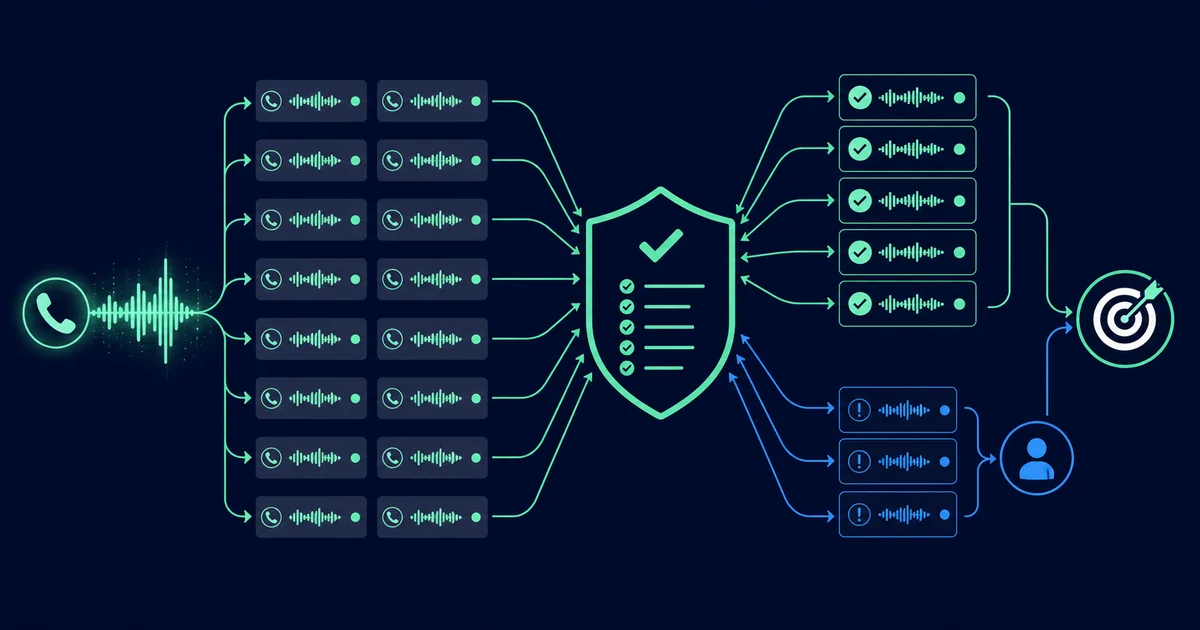
AI call quality assurance scores every eligible customer call against a defined, evidence-based scorecard, then routes uncertain or consequential results to people. Reaching 100% coverage does not mean trusting 100% of AI outputs. It means every eligible call enters the pipeline, every criterion can abstain when evidence is inadequate, and every automated judgment leaves a review trail that can drive coaching, calibration and correction.
What is AI call quality assurance?
AI call quality assurance is the systematic use of automated analysis to evaluate eligible customer calls against explicit quality criteria while preserving evidence, human oversight and correction paths.
The definition has four important parts. “Systematic” means the same eligibility rules and scorecard apply consistently. “Automated analysis” means software evaluates the recording or transcript. “Evidence” means each result points back to the relevant call moment. “Human oversight” means uncertain, disputed or consequential judgments can be reviewed and overridden.
AI call QA is therefore broader than a score. It is an operating system for deciding which calls enter evaluation, which criteria can be automated, when the system should abstain, how reviewers correct errors and how findings become coaching or process changes. For the mechanics of automated evaluation itself, start with the AI call scoring guide.
What does “score 100% of calls” actually mean?
A 100% call-QA coverage rate means every eligible call received an evaluation; it does not mean every captured call was eligible or every automated result was accepted without review.
Define the denominator before making a coverage claim. A disconnected call, corrupt recording, consent-related exclusion, test call or interaction below an agreed minimum-content rule may be legitimately ineligible. Hiding these calls makes the percentage meaningless; recording them in a coverage ledger makes it auditable.
Eligible calls = Captured calls − Valid exclusions
QA coverage rate = Evaluated eligible calls ÷ Eligible calls × 100
Pipeline exception rate = Eligible calls that failed evaluation ÷ Eligible calls × 100
Human-review rate = Human-reviewed evaluations ÷ Evaluated eligible calls × 100
Ledger field | Definition | Why it matters |
|---|---|---|
Captured calls | All calls received from the source system | Establishes the complete starting population |
Valid exclusions | Calls excluded under a documented rule and reason code | Prevents silent denominator changes |
Eligible calls | Captured calls minus valid exclusions | Defines the population that should be evaluated |
Evaluated calls | Eligible calls with a completed QA record | Supplies the coverage numerator |
Pipeline exceptions | Eligible calls without a completed record | Exposes ingestion, audio, transcript or scoring failures |
Human-reviewed calls | Evaluations examined by a person | Measures oversight workload, not coverage |
Illustrative example: 10,000 calls are captured, 300 meet documented exclusion rules and 9,700 are eligible. If all 9,700 receive a QA record, coverage is 100%. If 485 are routed to a person, the human-review rate is 5%. These inputs demonstrate the formula only; they are not an industry benchmark or CallOptix customer result.
Why manual sampling still matters—and where it fails
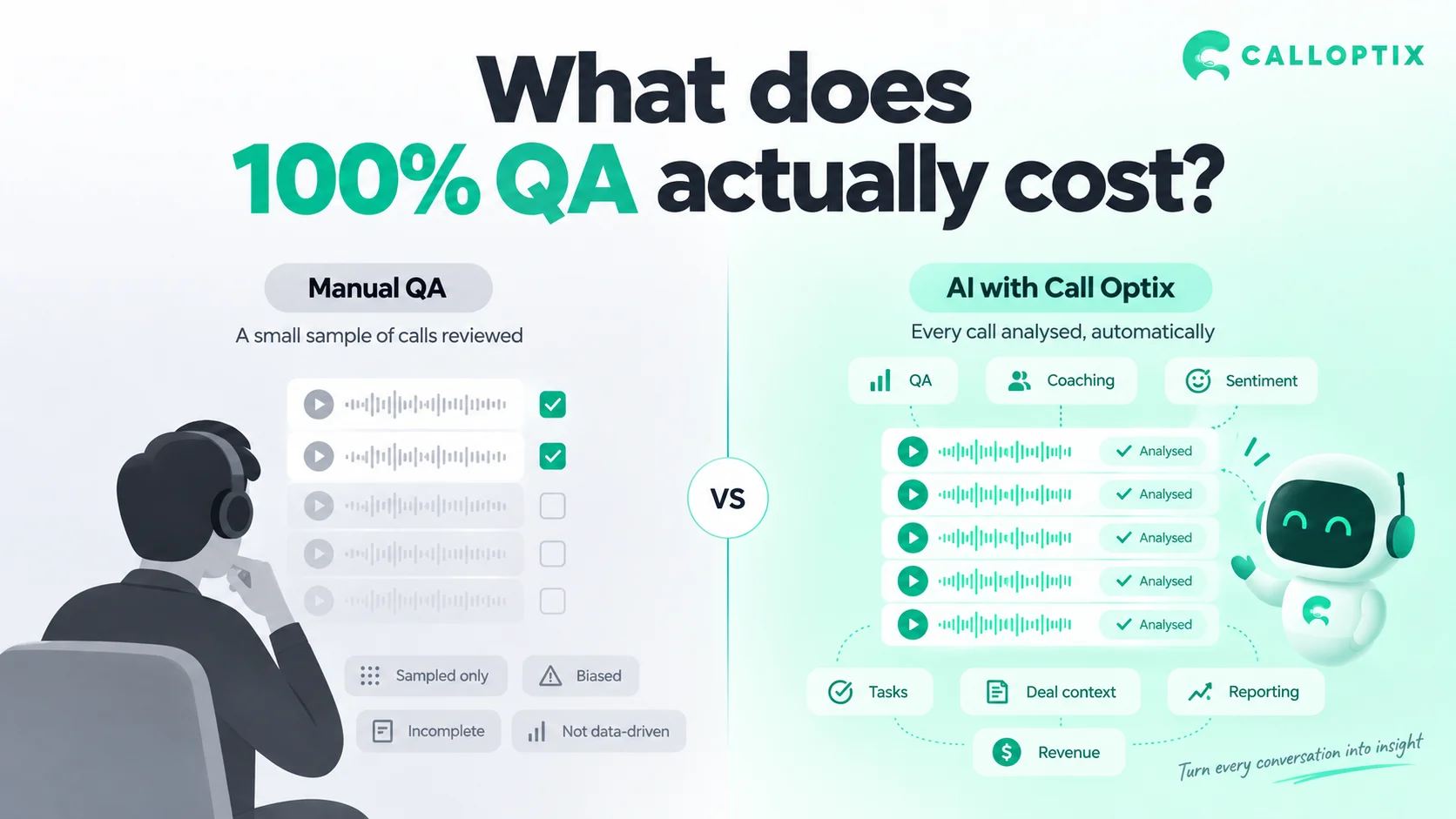
Manual QA provides contextual judgment, lets reviewers hear ambiguity and can handle criteria that are difficult to operationalize. Its limitation is not that people are incapable; it is that a sample answers a different question from full-population screening.
Method | What it is good at | What it misses or risks | Best role |
|---|---|---|---|
Manual random sample | Deep review of selected calls | Rare events, uneven call types and calls outside the sample | Calibration and exploratory review |
Manual targeted sample | Investigating known risks or specific agents | Population-level prevalence; selection can reinforce prior beliefs | Root-cause analysis |
Automated full coverage | Applying repeatable criteria to every eligible call | Context errors, model drift and false confidence | Screening, measurement and triage |
Hybrid QA | Broad automated coverage plus selective human review | Requires queue design, evidence and override discipline | Operational QA at scale |
A defensible manual sample should be stratified when the population is heterogeneous. Include relevant call types, teams, outcomes, languages, durations and risk classes rather than treating every call as interchangeable. Keep a random component so the program can discover issues it did not already know to target.
Automated coverage does not remove sampling. It changes sampling’s job: people no longer sample merely to create a score; they sample to validate the system, investigate edge cases, test for drift and review high-impact decisions.
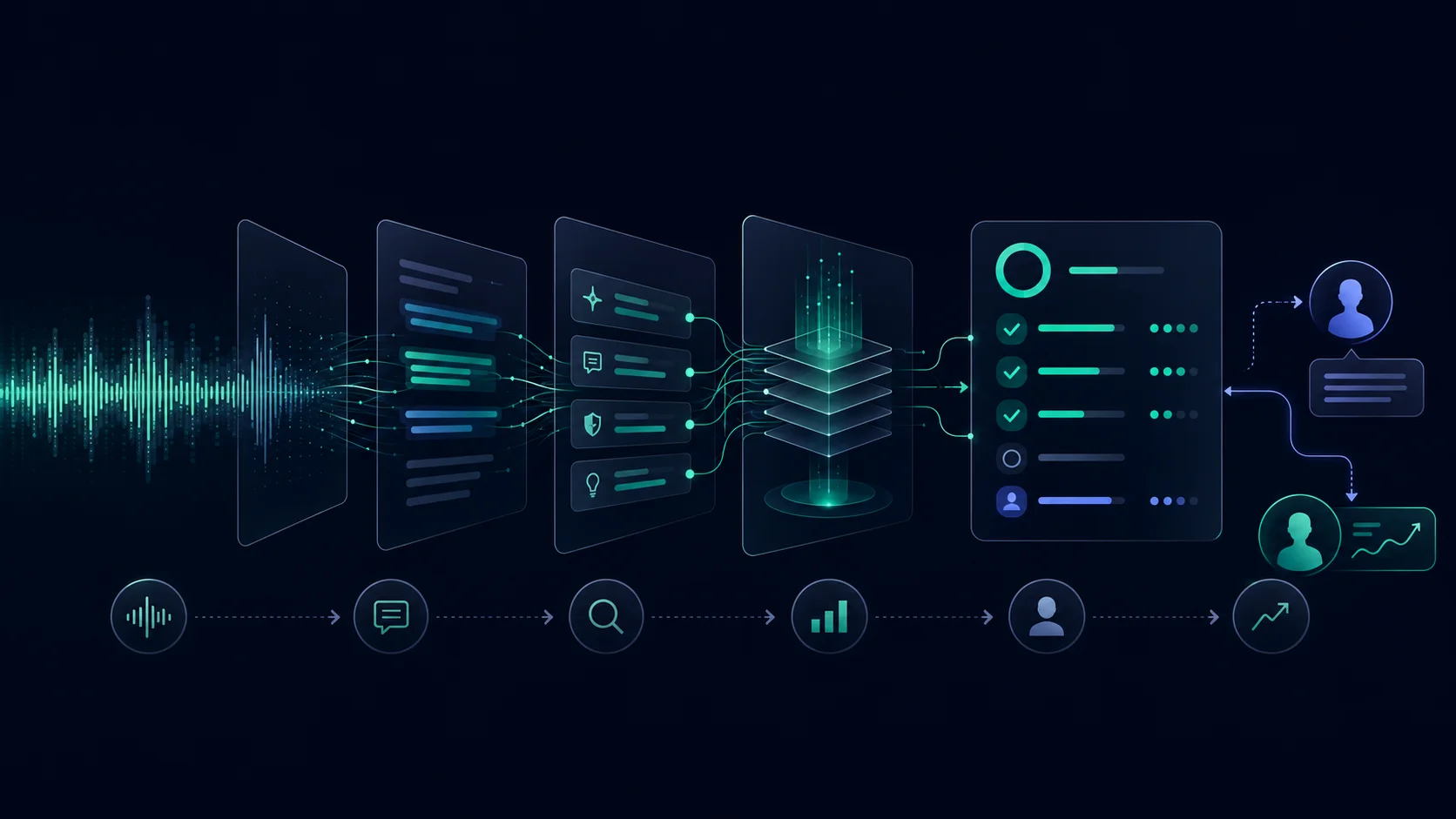
The eight-stage workflow for full-coverage AI call QA
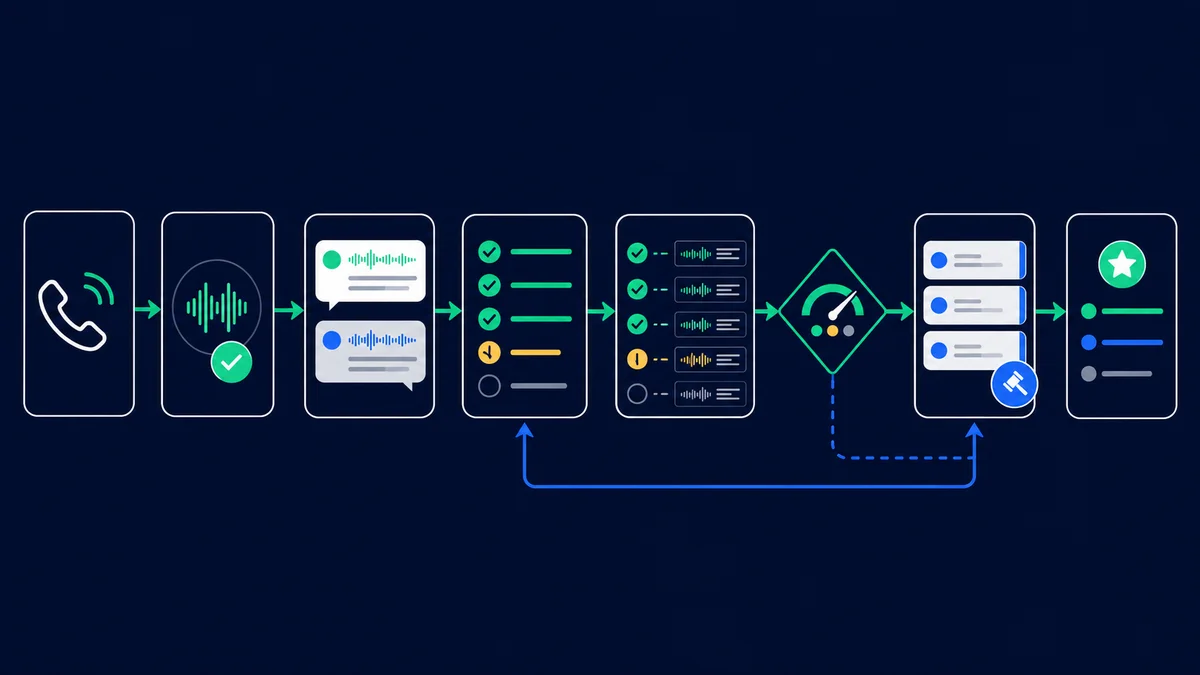
1. Capture every call and preserve source identifiers
Start with a call inventory, not a transcript folder. Retain a stable call ID, timestamp, source system, direction, agent or queue, recording status and any permitted business outcome. The stable ID must follow the call through transcription, scoring, review and coaching.
2. Apply explicit eligibility rules
Write exclusion rules before processing. Each exclusion needs a machine-readable reason such as test_call, no_recording, consent_exclusion, corrupt_audio or insufficient_content. Review exclusion rates by source and team; an exclusion spike may indicate a pipeline failure rather than a genuine change in call mix.
3. Validate audio and transcript quality
Conversation analysis normally depends on usable audio and a transcript with speaker structure. Twilio’s Conversation Intelligence onboarding documentation describes transcription as part of the preparation for intelligence extraction, while its Transcript resource documentation separates transcript content, sentences and analysis results.
Do not convert a poor transcript into a confident score. Record audio completeness, language detection, speaker separation, silence, overlapping speech and missing segments as quality signals available to the router.
4. Use observable, evidence-bearing criteria
A criterion should describe something a reviewer can locate in the interaction. “Confirmed the customer’s next step” is more automatable and coachable than “showed professionalism.” Each criterion should define applicability, allowed values, weight, required evidence, abstention conditions and consequence level.
The sales call scorecard template shows how to structure observable criteria, weights, N/A handling, auto-fail rules and machine-readable fields.
5. Produce criterion-level evidence before the total
For each criterion, store the result, the supporting transcript span or timestamp, an explanation limited to the evidence, and an abstain or review flag. Calculate the overall score only after criteria are complete. A total without criterion evidence is difficult to challenge, coach from or recalibrate.
6. Route by confidence and consequence
Do not use one universal threshold. A low-consequence coaching observation can tolerate more automation than a compliance, compensation or disciplinary decision. Route using both the reliability of the available evidence and the consequence of being wrong.
7. Review, override and adjudicate
A reviewer should be able to see the recording or transcript, scorecard rule, cited evidence and system result in one place. Overrides need a reason code and optional note. Repeated disagreement between reviewers requires adjudication; repeated disagreement with automation requires a scorecard, data or model investigation.
The NIST AI RMF Measure playbook recommends documenting human oversight, overrides, reported errors and adjudication activities. That maps directly to an auditable QA review log.
8. Turn findings into coaching and system feedback
A low score is not yet a coaching action. Group evidence into a specific behaviour, select a representative call moment, describe the expected alternative and record whether the coaching task was completed. Reviewer corrections should also feed the calibration set so the same error is less likely to recur.
How should confidence thresholds and human review work?
A confidence threshold is a routing boundary, not proof that a model’s answer is correct.
Some systems expose a probability-like score; others produce a label without calibrated probability. Do not present an arbitrary model number as confidence. Build a routing decision from observable signals: evidence present, audio usable, criterion applicable, output stable across checks, result near a pass boundary, reviewer disagreement history and consequence if wrong.
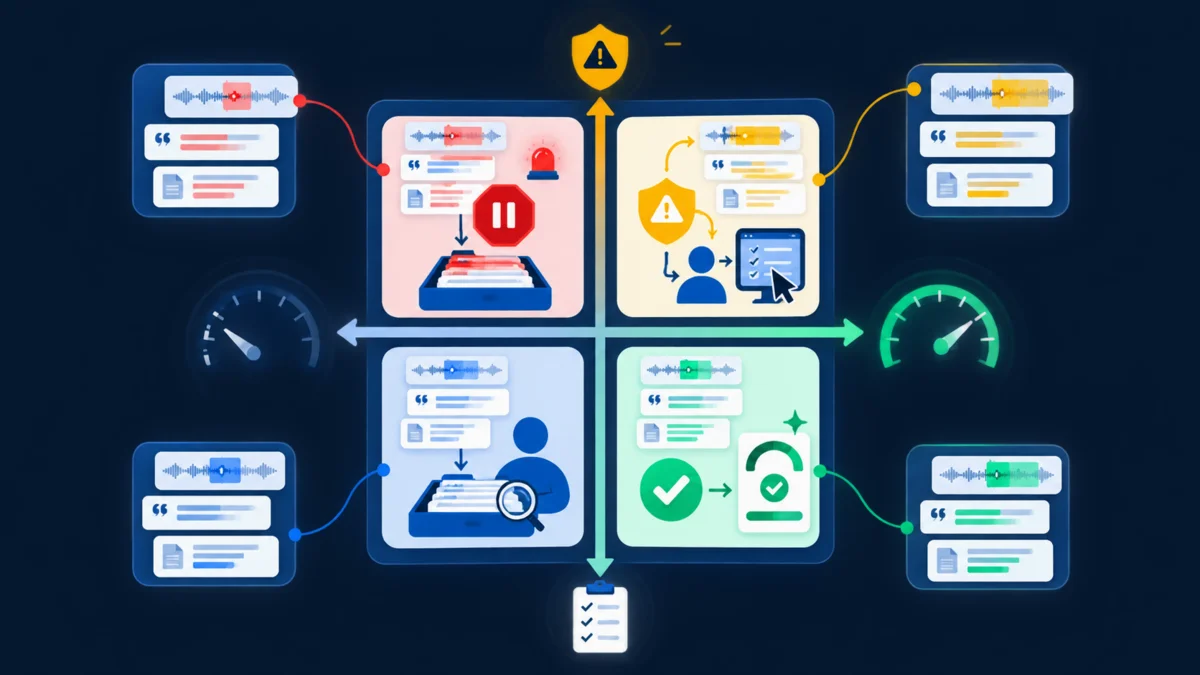
Evidence confidence | Consequence if wrong | Default route | Example |
|---|---|---|---|
High | Low | Accept provisionally; audit a random sample | Coaching observation with clear transcript evidence |
Low | Low | Queue for normal human review | Ambiguous empathy or call-control judgment |
High | High | Require human confirmation before consequential action | Clear missing disclosure used in a formal decision |
Low | High | Pause automation and prioritize expert review | Unclear identity-verification or prohibited-language finding |
High consequence can override high confidence. If a score affects pay, discipline, regulatory escalation or a customer remedy, define meaningful human responsibility instead of merely placing a person after the decision.
Ofqual’s principles for AI use in marking concern a different domain, but the governance lesson transfers: validity is context-specific, benefits require empirical validation, and high-stakes automated judgments need meaningful oversight. This is an inference applied to call QA, not a claim that call scoring is regulated like educational marking.
How to build a reliable calibration process
- 1
Create a reference set that represents the actual call population: common calls, rare risks, difficult audio, multiple teams, relevant languages and both positive and negative examples.
- 2
Have at least two qualified reviewers independently score a subset before discussing disagreements. Otherwise, automation may be calibrated to one person’s undocumented preferences.
- 3
Measure agreement criterion by criterion, not only on the total score. A similar total can hide opposite decisions on important criteria.
- 4
Adjudicate disagreements and update the written criterion, examples or applicability rule. Do not solve every disagreement by changing the model.
- 5
Test automation against the adjudicated reference set and record false positives, false negatives, abstentions and evidence quality.
- 6
Set routing rules based on error cost and operational capacity. Label every threshold as an initial policy choice until production evidence supports it.
- 7
Recheck performance after scorecard, model, transcript, telephony, language mix or policy changes.
NIST’s AI RMF Manage playbook recommends monitoring deployed systems for performance shifts and drift, maintaining feedback mechanisms, documenting issues and supporting appeal or override. A QA calibration cadence should therefore be event-triggered as well as calendar-based.
Which metrics prove the QA workflow is working?
Metric | Formula | What it diagnoses |
|---|---|---|
QA coverage rate | Evaluated eligible calls ÷ eligible calls × 100 | Whether the full population entered evaluation |
Pipeline exception rate | Failed eligible evaluations ÷ eligible calls × 100 | Ingestion, audio, transcript or scoring reliability |
Evidence-completeness rate | Criteria with required evidence ÷ applicable scored criteria × 100 | Whether results are reviewable |
Automation override rate | Overridden automated results ÷ human-reviewed automated results × 100 | Where automation and reviewers disagree |
Human agreement rate | Matching independent human judgments ÷ double-reviewed judgments × 100 | Scorecard clarity and reviewer calibration |
Review turnaround | Review completion time − queue entry time | Whether risk routing is operationally useful |
Coaching closure rate | Completed coaching actions ÷ assigned coaching actions × 100 | Whether findings become action |
Do not set universal targets from a generic article. Establish a baseline by call type and criterion, then set tolerances based on consequence, reviewer capacity and observed error. A compliance criterion may demand a different evidence-completeness and review policy from a coaching observation.
Track the denominator beside every rate. A falling override rate can mean improvement, or it can mean reviewers stopped checking difficult cases. Pair metrics with queue composition and exclusion reasons.
A practical implementation plan
Phase 1: Define the decision and denominator
Choose one scorecard and one operational use. Document captured, excluded, eligible, evaluated and reviewed states. Assign owners for the scorecard, data pipeline, human review and coaching.
Phase 2: Build the evidence-first pipeline
Process historical calls, but keep results out of formal performance decisions. Verify stable IDs, exclusions, transcript quality, criterion evidence and audit fields. Use the manual sales call audit workflow to compare what a manager needs to see with what the automated record provides.
Phase 3: Calibrate in shadow mode
Run automated QA alongside the existing human process. Review disagreements, not just averages. Refine criteria that cannot be applied consistently and add abstention rules for unsupported cases.
Phase 4: Launch risk-tiered routing
Automate low-consequence, well-supported results first. Require review for low confidence, high consequence, complaints, appeals, new criteria and unfamiliar call segments. Publish an override and escalation process.
Phase 5: Close the coaching loop
Select coaching moments from repeated, evidence-backed behaviour—not isolated low totals. Track assignment, completion, manager notes and later evidence of the same behaviour. The aim is better calls, not merely more scores.
Phase 6: Monitor drift and governance
Watch changes in exclusions, transcript quality, agreement, overrides and queue mix. Revalidate after upstream or policy changes. Archive scorecard versions so an old call can be interpreted using the rules that were active when it was scored.
Privacy and employee monitoring considerations
Call recording, transcription and agent scoring can involve personal data and workplace monitoring. The UK Information Commissioner’s Office says workers should be informed about monitoring and how it is used for decisions affecting them; it also recommends considering a data protection impact assessment where appropriate. See the ICO guidance on specific monitoring methods and data protection and monitoring workers.
Requirements depend on jurisdiction and context. Before deployment, define purpose, lawful basis, notices, access, retention, security, appeal and whether any decision is solely automated. Treat this section as an implementation checklist, not legal advice.
Frequently asked questions
Does 100% QA coverage mean every call receives a numeric score?
No. Every eligible call should receive an evaluation record, but some criteria or entire calls may validly return N/A, abstain or human_review_required when evidence is insufficient.
Can AI replace call-center QA analysts?
AI can take over population screening and repeatable evidence extraction. Analysts remain necessary for calibration, complex judgment, adjudication, appeals, governance and translating findings into operational change.
How many calls should humans still review?
There is no universal percentage. Determine the review volume from risk tiers, uncertainty, model and reviewer agreement, new call segments, complaints, random audits and available capacity.
Should low-confidence calls receive a score?
They can receive a provisional result, but the record should clearly distinguish provisional from accepted. For unsupported criteria, abstaining is usually more honest than manufacturing a score.
Can one QA scorecard be used across every team?
A shared core may be useful, but criteria, applicability and consequences should reflect the call type and business process. Test agreement separately across material segments before combining results.
What should trigger immediate human review?
Typical triggers include missing evidence, unusable audio, low confidence, high-consequence criteria, near-boundary results, complaints, model disagreement, appeals and newly deployed scorecard rules.
How often should AI call QA be recalibrated?
Use both a regular cadence and event triggers. Recalibrate when the scorecard, model, transcription, telephony, language mix, products, scripts or policies change, or when monitoring shows drift.
Full coverage should increase scrutiny, not remove it
The reliable path to 100% QA coverage is not “let AI decide everything.” It is: define the eligible population, evaluate every eligible call, require evidence, let the system abstain, route by confidence and consequence, preserve overrides and turn repeated findings into coaching.
Planning a full-coverage call QA workflow? Talk to CallOptix about your scorecard and review process. Bring your current QA form, exclusion rules and the decisions the scores will support.
Related Articles
Get the Latest Insights
Get the latest insights on call center optimization and AI-powered sales strategies delivered to your inbox.
By subscribing you agree to receive marketing emails. Unsubscribe anytime.