
Conversation Intelligence vs Call Analytics vs Call Tracking
Compare conversation intelligence, call analytics and call tracking by data, outputs, limits and use cases—then choose the right call-data layer.

Call tracking connects a call to its acquisition source. Call analytics measures the call as an operational event—whether it was answered, how long it lasted, where it was routed and what outcome was recorded. Conversation intelligence analyzes the words and interaction to find topics, objections, commitments and coaching evidence. In short: tracking asks “Where did it come from?”, analytics asks “What happened?”, and conversation intelligence asks “What was said, and what does it mean?”
Conversation intelligence vs call analytics vs call tracking: the short answer
These terms are often used as if they were interchangeable. They are not. They describe three different levels of evidence about the same call. Product vendors may bundle them together or use broader labels, so evaluate the data a system receives and the decisions it supports—not the category name on its homepage.
Category | Primary question | Core input | Typical output | Best-fit decision |
|---|---|---|---|---|
Call tracking | Where did the call come from? | Phone-number, campaign and session attribution data | Source, campaign, keyword or visitor journey | Which marketing source generated the call? |
Call analytics | What happened operationally? | Call-event and routing metadata | Volume, answer status, duration, queue time, route and disposition | Where is call handling breaking down? |
Conversation intelligence | What was said and what does it mean? | Recording or transcript plus context | Topics, questions, objections, actions and evaluation evidence | What should a manager, rep or process change? |
Exact definitions
What is call tracking?
Call tracking is the practice of linking an inbound phone call to the marketing source, campaign, advertisement or visitor session that generated it.
A common web implementation is dynamic number insertion: the visitor sees a source-specific forwarding number, while the call still reaches the intended destination. Twilio’s official definition of dynamic number insertion describes this source-to-number mapping. Google Ads call reporting likewise uses forwarding numbers to measure calls generated by ads and call assets.
Call tracking is primarily an attribution layer. It can tell marketing teams which source produced a call and, depending on configuration, connect the call to a campaign or web session. It cannot, by itself, establish whether the agent handled the conversation well or whether the caller’s need was resolved.
What is call analytics?
Call analytics is the measurement and reporting of calls as operational events using metadata such as volume, answer status, duration, queue time, routing and recorded outcomes.
There is no universal product taxonomy for “call analytics.” Some platforms use the term for operational dashboards; others include attribution, transcription or content analysis. This article uses a deliberately narrow operational definition so buyers can compare evidence consistently.
The key test is simple: if the system can answer how many calls arrived, when they arrived, which were missed, how long they waited or where they were routed without examining the words spoken, it is performing call analytics.
What is conversation intelligence?
Conversation intelligence is the analysis of recorded or transcribed interactions to extract meaning, behaviours, topics, commitments and evidence for decisions.
Content analysis requires access to the conversation itself. Twilio’s Conversation Intelligence onboarding documentation treats transcription as a prerequisite for insight extraction, while its Transcript resource documentation separates the transcript, sentence-level content and analysis results. Its Language Operators documentation then describes applying AI or machine-learning operators to transcripts.
Conversation intelligence can support quality review, coaching, discovery analysis and structured follow-up. It is not ground truth: its output depends on recording quality, transcription, speaker separation, language handling, rubric design and human oversight.
Think in call-data layers, not product labels
The categories are easiest to understand as a stack. Tracking creates the acquisition record. Analytics adds operational context. Conversation intelligence adds the content and meaning layer. A system may provide one, two or all three, but a combined interface does not erase the differences between the underlying evidence.
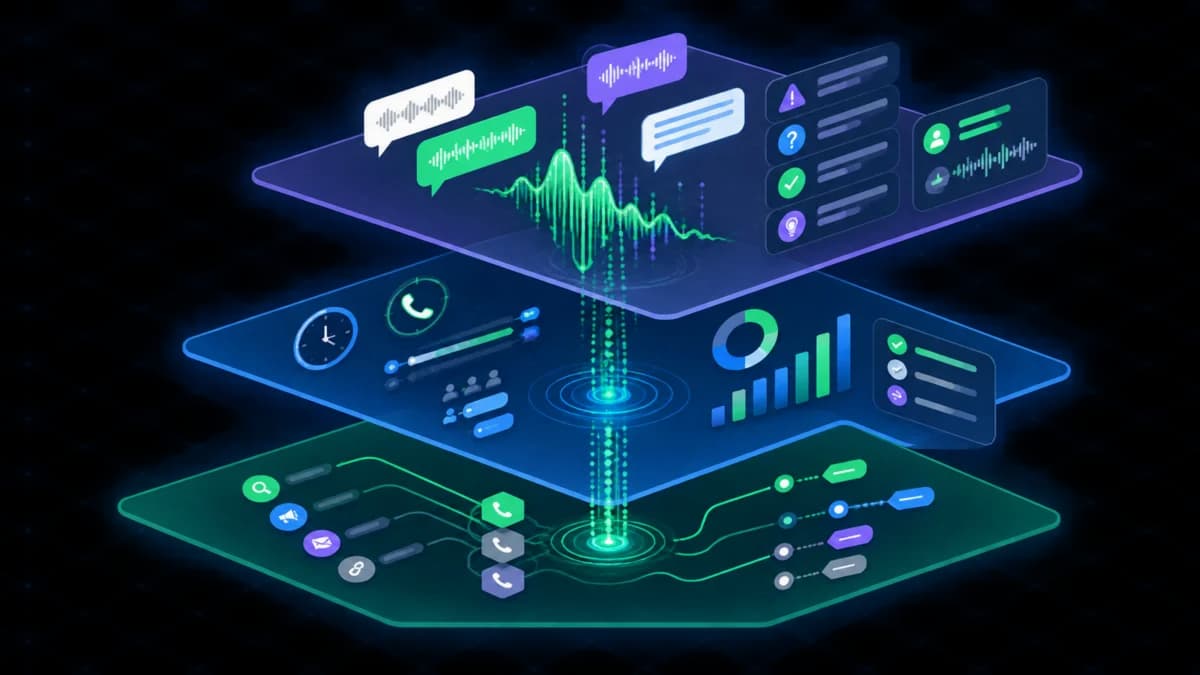
This layered model prevents a common buying mistake: selecting a feature-rich platform before defining the question. If a hotel only needs to identify which campaign produces reservation calls, transcript analysis may add cost and governance work without improving the attribution decision. If a sales manager needs to understand why qualified calls stall, campaign attribution alone is insufficient.
One call can produce three different records
Consider one illustrative inbound sales call. The example below is not a benchmark, customer result or product claim; it shows how the same event appears at each layer.
Layer | Illustrative record | What it supports |
|---|---|---|
Call tracking | Paid-search campaign → landing page → forwarding number → inbound call | Attribute the call to an acquisition path |
Call analytics | Answered; queue time 23 seconds; duration 6 minutes 42 seconds; routed to sales | Review staffing, routing and handling patterns |
Conversation intelligence | Buyer asks about data residency; rep promises a follow-up; next step is a demo on Friday | Review discovery quality, commitments and coaching evidence |
No single row is a substitute for the others. The tracking record cannot prove that the buyer received a useful answer. The duration cannot prove engagement or quality. The transcript-derived record cannot reliably calculate campaign return unless it is joined to attribution and commercial outcome data.
What call tracking can and cannot tell you
Best uses for call tracking
Compare which campaigns, ads, landing pages or sources generate calls.
Route calls through source-specific numbers while preserving the destination.
Connect a phone enquiry to the acquisition journey when the implementation captures the required identifiers.
Optimize marketing toward qualified call outcomes when attribution data is joined to a trustworthy downstream outcome.
Limitations of call tracking
It does not explain the content or quality of the conversation.
Attribution can be incomplete when a number is copied, shared, viewed on another device or dialled outside the tracked session.
A call click is not always a completed call. Google’s website call-conversion guidance distinguishes tracking a mobile number click from tracking an actual call.
Forwarding-number coverage and configuration rules vary by channel and platform.
For setup details, see Google’s website call-tracking documentation and its call-conversion tracking guidance. The implementation choice determines what the attribution record can legitimately claim.
What call analytics can and cannot tell you
Best uses for call analytics
Monitor inbound volume by hour, day, team, location or route.
Find missed-call, abandonment, wait-time or transfer patterns.
Compare operational handling across queues or business units when definitions are consistent.
Create alerts for unusual call-event patterns.
Limitations of call analytics
Duration is not quality: a long call can be productive, confused or simply delayed.
Answer rate does not reveal whether the caller’s need was resolved.
A disposition is only as reliable as the process or person assigning it.
Operational metrics explain where a problem appears, but usually not why it happened.
Use call analytics to locate the operational segment worth investigating. Then inspect the process, disposition quality or conversation evidence needed to explain the pattern.
What conversation intelligence can and cannot tell you
Best uses for conversation intelligence
Find recurring questions, objections, commitments and next steps across calls.
Provide evidence for a sales-call audit or quality-assurance review.
Support coaching against observable behaviours rather than memory.
Structure evaluation criteria with a transparent scorecard and review process.
If your immediate goal is evaluation, use a defined method such as the AI call scoring guide, the 20-criterion sales call scorecard template or the sales call audit guide. These workflows turn conversation evidence into a reviewable decision.
Limitations of conversation intelligence
It depends on usable audio, accurate transcription and correct speaker separation.
Language, accent, code-switching, background noise and domain vocabulary can affect downstream interpretation.
Topics, sentiment and automated scores are model outputs, not indisputable facts.
A weak rubric can automate the wrong judgment at scale.
Recording and transcription introduce privacy, retention and access-control obligations.
A sensible control is evidence-first review: keep the transcript span or call moment that supports each finding, define confidence thresholds, and route uncertain or high-impact cases to a human.
How to choose the right category
Start with the business decision, not the feature list. The smallest sufficient evidence layer is often the best starting point.
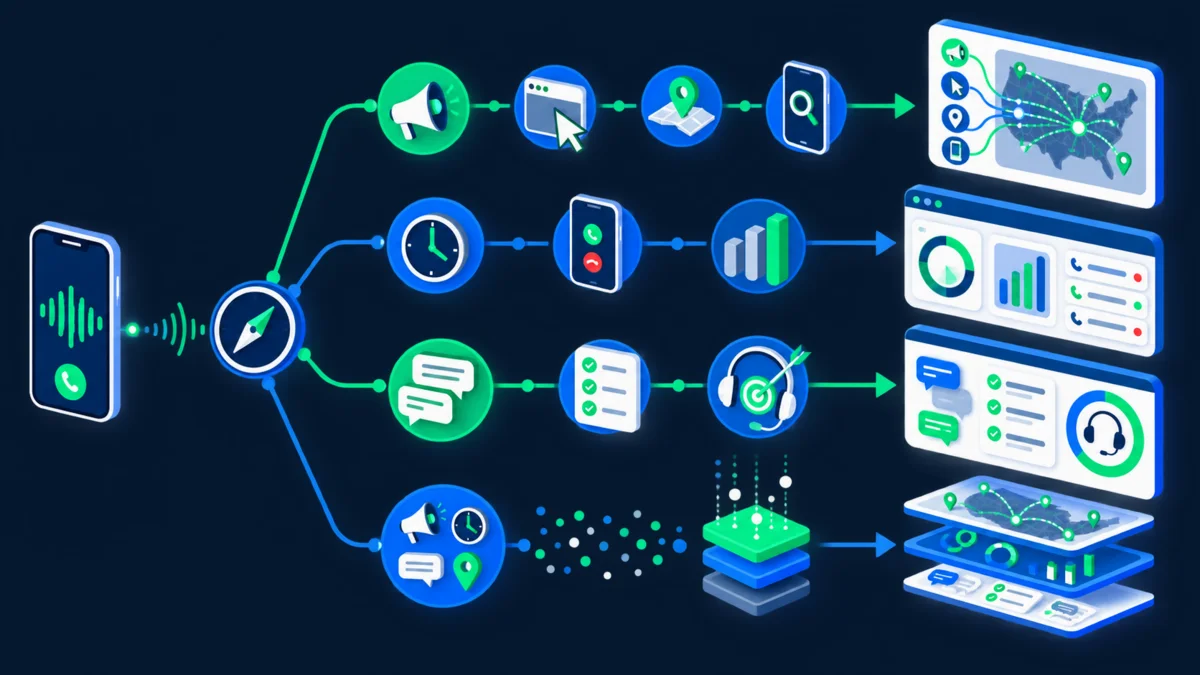
If you need to decide… | Start with… | Add another layer when… |
|---|---|---|
Which campaign generated calls? | Call tracking | You also need to qualify the call or connect it to conversation outcomes |
Where calls are missed or delayed? | Call analytics | You need to understand the process or conversation causing the failure |
How reps handle discovery, objections or next steps? | Conversation intelligence | You also need campaign attribution or queue context |
Which campaigns produce well-handled, qualified conversations? | All three layers | You need attribution, operations, content and a trusted business outcome joined together |
A five-question buying checklist
- 1
What exact decision must the system improve in the next 90 days?
- 2
Which input proves that decision: source metadata, call-event metadata, conversation content or a combination?
- 3
What output will a named role act on each week?
- 4
What failure mode would make that output misleading?
- 5
What human review, privacy and retention controls are required?
Ask vendors to demonstrate the complete chain from input to action. A dashboard label is not evidence. For example, ask what data creates an “objection” flag, whether the supporting transcript span is visible, how corrections are handled and whether the result can be joined to the call’s source and outcome.
Privacy and governance change with the data layer
Tracking and operational metadata can be less intrusive than recording the conversation itself. The UK Information Commissioner’s Office advises employers to consider whether itemized call records would achieve the purpose instead of accessing call content, and to inform workers about monitoring. See the ICO guidance on monitoring workers.
When conversations are recorded or transcribed, document why the data is collected, how it will be used, how long it will be retained and who may access it. The ICO’s recording and data-sharing guidance emphasizes explaining the purpose, use and retention of recordings. Its data protection by design guidance recommends considering privacy throughout the system lifecycle.
Legal requirements vary by jurisdiction and context. Treat this as a product-design checklist, not legal advice: establish a lawful basis, give appropriate notices, limit collection, restrict access, define retention and provide a review path before deployment.
A practical implementation sequence
- 1
Name one decision and one accountable owner. Example: a marketing lead wants source-level qualified-call reporting, or a sales manager wants evidence-based objection coaching.
- 2
Define the minimum evidence. Do not record content when call-event metadata is sufficient.
- 3
Document field definitions. Specify what counts as answered, missed, transferred, qualified and converted.
- 4
Test edge cases. Include forwarded calls, repeat callers, copied numbers, short calls, silence, multiple speakers and unclear outcomes.
- 5
Join layers only with stable identifiers and documented timing rules. Avoid implying causal attribution from a loose timestamp match.
- 6
Sample outputs manually before automating action. Review both correct and incorrect cases.
- 7
Measure decision quality, not dashboard activity. A used dashboard is not necessarily a better decision.
This sequence also keeps category expansion intentional. A team can begin with tracking, add operational analytics when routing becomes the bottleneck, and introduce conversation analysis when the unanswered question moves from “where?” to “why?”
Frequently asked questions
Is call tracking the same as call recording?
No. Call tracking links a call to a source or journey. Call recording captures the audio content. A product may offer both, but they are separate functions with different data and privacy implications.
Is call analytics the same as conversation intelligence?
Not under the definitions used here. Call analytics measures call events and operations; conversation intelligence analyzes what was said. Vendor terminology overlaps, so verify inputs and outputs rather than relying on the label.
Do I need all three categories?
Only if the decision requires all three layers. Marketing attribution may need tracking alone; staffing may need operational analytics; coaching may need conversation intelligence. Cross-functional revenue analysis often needs the layers joined.
Can conversation intelligence work without call tracking?
Yes. It can analyze a recording or transcript without knowing the marketing source. You need call tracking only when acquisition attribution is part of the decision.
Which category is best for marketing teams?
Call tracking is the usual starting point for source and campaign attribution. Add conversation intelligence when marketing must distinguish a raw call from a relevant, qualified or outcome-bearing conversation.
Which category is best for sales coaching?
Conversation intelligence is the closest fit because coaching depends on what the rep and buyer said. Use a transparent scorecard, preserve supporting evidence and keep human review for uncertain or consequential judgments.
What privacy controls should be in place before recording or transcription?
Document the purpose and lawful basis, provide appropriate notices, minimize the data collected, restrict access, set retention limits, secure the records and establish a process for human review and data-subject requests.
Choose the evidence before the platform
The category decision becomes straightforward when the business question is precise: use tracking for origin, analytics for operational events and conversation intelligence for meaning. Combine them only when the decision genuinely crosses those boundaries.
Evaluating a call-intelligence workflow for QA, coaching or revenue operations? Talk to CallOptix about your use case and bring the decision, evidence and governance checklist above.
Related Articles
Get the Latest Insights
Get the latest insights on call center optimization and AI-powered sales strategies delivered to your inbox.
By subscribing you agree to receive marketing emails. Unsubscribe anytime.