
Hotel Reservation Call Script: Questions and Objections
Copy a hotel reservation call script with English and Hindi examples, OTA objection responses, transparent pricing, closing and follow-up.
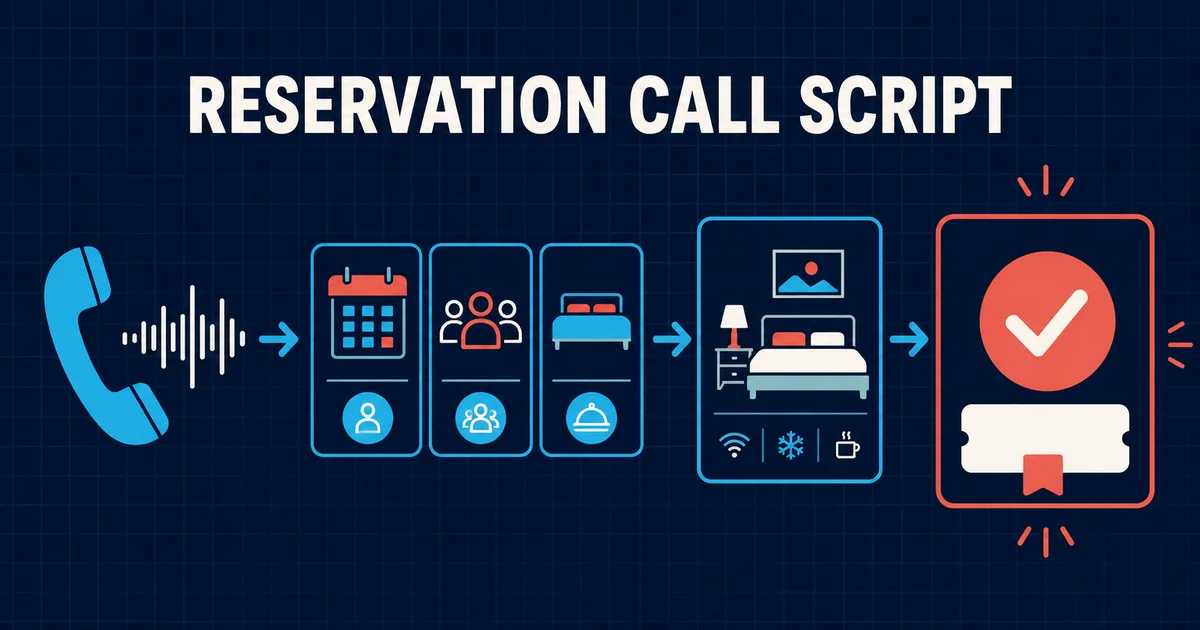
A hotel reservation call script should help an agent discover the stay context, recommend the most relevant available room, present the complete price clearly, answer objections honestly and secure an explicit next step. It is a decision guide, not a speech to recite. The English and Hindi examples below show the full method using a clearly labelled fictional property and illustrative inputs.
What is a hotel reservation call script?
A hotel reservation call script is a structured conversation guide that defines the questions, explanations and confirmation steps an agent should use when handling a room enquiry by phone.
The structure matters more than identical wording. A caller who asks only for price needs a different conversation from a family comparing room layouts, a business traveller checking arrival time or a guest who already found an OTA listing. The script should keep the required facts consistent while leaving room for listening and judgment.
This guide treats the call as an eight-stage evidence path. Each stage should produce a usable fact, a clear recommendation or an agreed next action. That makes the script easier to coach than a long block of memorised dialogue. For broader context on manual review, see the Sales Call Audit Guide.
The eight-step hotel reservation call flow
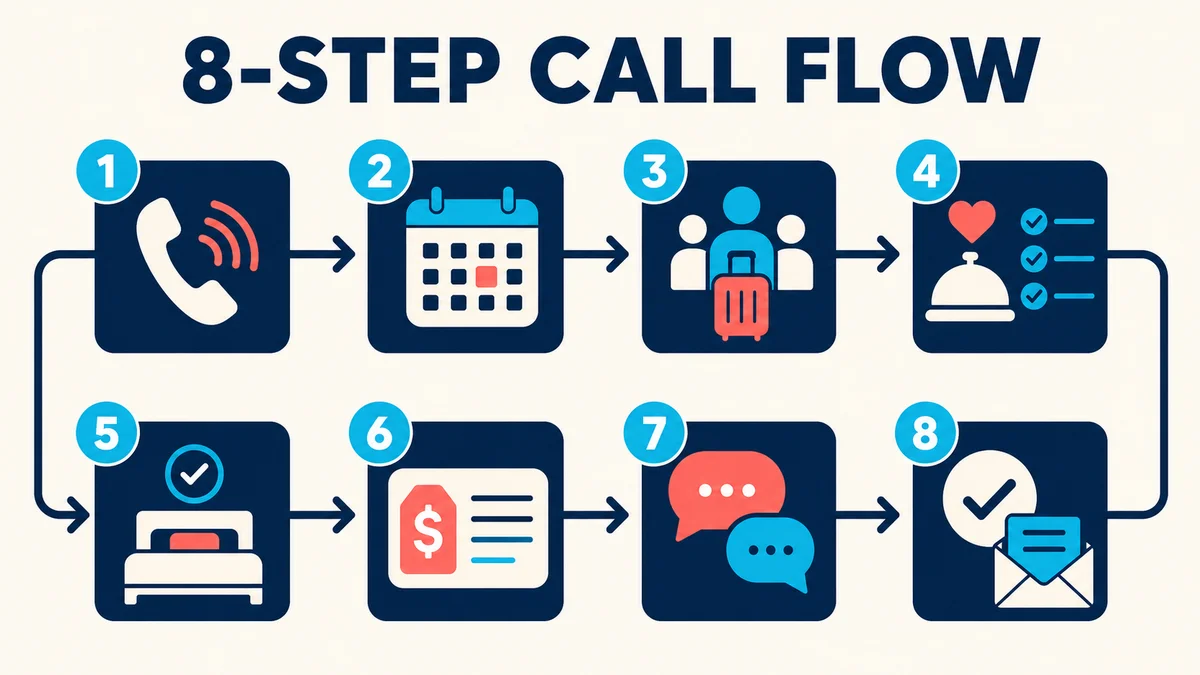
Stage | Agent objective | What should be clear before moving on |
|---|---|---|
1. Greet | Identify the property and yourself; invite the enquiry | Why the guest called |
2. Dates | Confirm arrival, departure and flexibility | Exact stay dates and number of nights |
3. Party | Confirm adults, children and room count | Occupancy and any age-dependent requirements |
4. Needs | Ask purpose, bed, accessibility and priority questions | The two or three factors that drive the recommendation |
5. Match | Recommend one primary option and one meaningful alternative | Why each option fits the stated need |
6. Price | State rate basis, stay total, inclusions, mandatory charges, taxes and policy | What is payable, included and changeable |
7. Resolve | Clarify the concern before responding | Whether the issue is price, policy, trust, room fit or timing |
8. Confirm | Recap details and secure booking or a dated follow-up | Reservation status and next action |
Do not force every caller through every question. If the guest has already supplied a fact, confirm it rather than asking again. If a requested room is unavailable, preserve the purpose behind the request: explain that the exact category is unavailable, restate the guest’s priority and offer the closest verified alternative.
1. Open the call and earn permission to ask
English: “Good morning, thank you for calling Lotus Bay Hotel. This is Anita. How may I help with your stay?”
Hindi: “नमस्कार, लोटस बे होटल में आपका स्वागत है। मैं अनीता बोल रही हूँ। आपकी यात्रा के लिए मैं कैसे सहायता कर सकती हूँ?”
If the caller immediately asks for a rate, acknowledge the request before discovery: “Certainly. May I confirm the dates and number of guests so I quote the correct available option?” This explains why the questions are necessary.
2. Confirm the booking facts
Use the smallest set of questions that changes availability, suitability or price.
Dates: “What date will you arrive, and what date will you check out?”
Party: “How many adults and children will be staying, and how many rooms do you need?”
Purpose: “Is this a business trip, family stay, celebration or something else?”
Priority: “What matters most: room size, bed type, view, quiet location, accessibility or staying within a budget?”
Timing: “What time do you expect to arrive?”
Ask only questions your team can use. A discovery form that collects ten preferences but changes nothing in the recommendation creates friction and unreliable notes.
3. Recommend, do not merely list
A recommendation has three parts: the option, the reason and the trade-off. For example: “Based on two adults, a late arrival and your preference for a quiet room, I recommend the Deluxe King because it is in the quieter wing. The Courtyard Queen is the lower-priced alternative, but it has a queen bed.”
Never invent scarcity, an upgrade, a rate guarantee or an inclusion. If availability can change before payment, say so. If a benefit applies only to direct bookings, confirm that it is genuinely available for the caller’s dates and rate plan before mentioning it.
Copyable English hotel reservation call script
Illustrative example: Lotus Bay Hotel, the people, room names, dates, prices, policies and reference below are fictional training inputs—not a benchmark or a CallOptix customer result.
Turn | Copyable line | Purpose |
|---|---|---|
Agent | Good morning, thank you for calling Lotus Bay Hotel. This is Anita. How may I help? | Clear greeting |
Guest | I need a room from 12 to 14 September for two adults. | Initial intent |
Agent | Certainly. Is one room correct, and what matters most for this stay—bed type, quiet location, accessibility, view or budget? | Minimum facts and priority |
Guest | One room. A quiet king room with breakfast. | Need |
Agent | I recommend the Deluxe King because it is in the quieter wing and breakfast is included. The Courtyard Queen is the lower-priced alternative, but it has a queen bed. | Relevant recommendation |
Agent | For this illustration, the rate is ₹6,000 per night for two nights. The ₹12,000 room subtotal, ₹500 mandatory charge and ₹1,000 applicable taxes make the stay total ₹13,500. The training policy allows free cancellation until 6 p.m. two days before arrival; after that, one night is charged. | Transparent rate and fictional policy |
Guest | I saw a lower price on an OTA. | Objection |
Agent | Let me compare the same dates, occupancy, room type, breakfast and cancellation terms. What total and conditions are you seeing? | Like-for-like clarification |
Guest | It is ₹13,200, but breakfast is not included and it cannot be cancelled. | Comparison |
Agent | The direct example is ₹13,500 with breakfast and the cancellation terms I explained. If those differences matter, shall I secure the Deluxe King? | Decision close without disparaging OTA |
Guest | Please book it. | Commitment |
Agent | I’ll recap before payment: 12 to 14 September, two adults, one Deluxe King with breakfast, total ₹13,500, and the cancellation terms just explained. Is each detail correct? | Explicit confirmation |
Agent | Your fictional training reference is LBH-4821. I’ll send the confirmation now. Please check the dates, names, total and policy when it arrives. | Handoff |
A live property should replace every fictional fact above with information retrieved from current inventory, rate, policy and payment systems during the call. Do not teach agents to memorise the illustrative numbers.
Copyable Hindi hotel reservation call script
Use natural Hindi or Hinglish that matches the caller. Do not translate a policy loosely; read the approved policy wording or explain it accurately in the caller’s preferred language. This example uses the same fictional training inputs as the English script.
स्थिति | कॉपी करने योग्य पंक्ति | उद्देश्य |
|---|---|---|
अभिवादन | नमस्कार, लोटस बे होटल में आपका स्वागत है। मैं अनीता बोल रही हूँ। मैं आपकी कैसे सहायता कर सकती हूँ? | कॉल की स्पष्ट शुरुआत |
तारीखें | कृपया चेक-इन और चेक-आउट की तारीख, मेहमानों की संख्या और कमरों की संख्या बताएँ। | मुख्य जानकारी |
ज़रूरत | आपके लिए सबसे ज़रूरी क्या है—बेड टाइप, शांत कमरा, एक्सेसिबिलिटी, व्यू या बजट? | प्राथमिकता |
सुझाव | आपकी ज़रूरत के अनुसार डीलक्स किंग बेहतर विकल्प है, क्योंकि यह शांत विंग में है और नाश्ता शामिल है। कम कीमत वाला विकल्प कोर्टयार्ड क्वीन है, लेकिन उसमें क्वीन बेड है। | संबंधित विकल्प |
कुल कीमत | इस काल्पनिक उदाहरण में प्रति रात दर ₹6,000 है। दो रातों का रूम सबटोटल ₹12,000, अनिवार्य शुल्क ₹500 और लागू टैक्स ₹1,000 मिलाकर कुल ₹13,500 है। | स्पष्ट मूल्य |
कैंसलेशन | इस ट्रेनिंग उदाहरण में आगमन से दो दिन पहले शाम 6 बजे तक मुफ्त कैंसलेशन है; उसके बाद एक रात का शुल्क लगेगा। | नीति |
OTA आपत्ति | आइए समान तारीख, ऑक्यूपेंसी, रूम टाइप, नाश्ता और कैंसलेशन शर्तों की तुलना करें। वहाँ आपको कुल कीमत और शर्तें क्या दिख रही हैं? | समान तुलना |
समापन | मैं बुकिंग से पहले दोहरा देती हूँ: 12 से 14 सितंबर, दो मेहमान, एक डीलक्स किंग, नाश्ता शामिल, कुल ₹13,500 और वही कैंसलेशन शर्तें। क्या सब सही है? | स्पष्ट सहमति |
फॉलो-अप | आपका काल्पनिक ट्रेनिंग रेफरेंस LBH-4821 है। मैं कन्फर्मेशन भेज रही हूँ। कृपया तारीख, नाम, कुल कीमत और पॉलिसी जाँच लें। | रिकॉर्ड और अगला कदम |
Hinglish alternative for a price-first caller: “Bilkul. Correct available rate batane ke liye dates, guests aur room preference confirm kar doon?” This keeps the tone conversational while preserving the required facts.
How should an agent present the hotel rate?
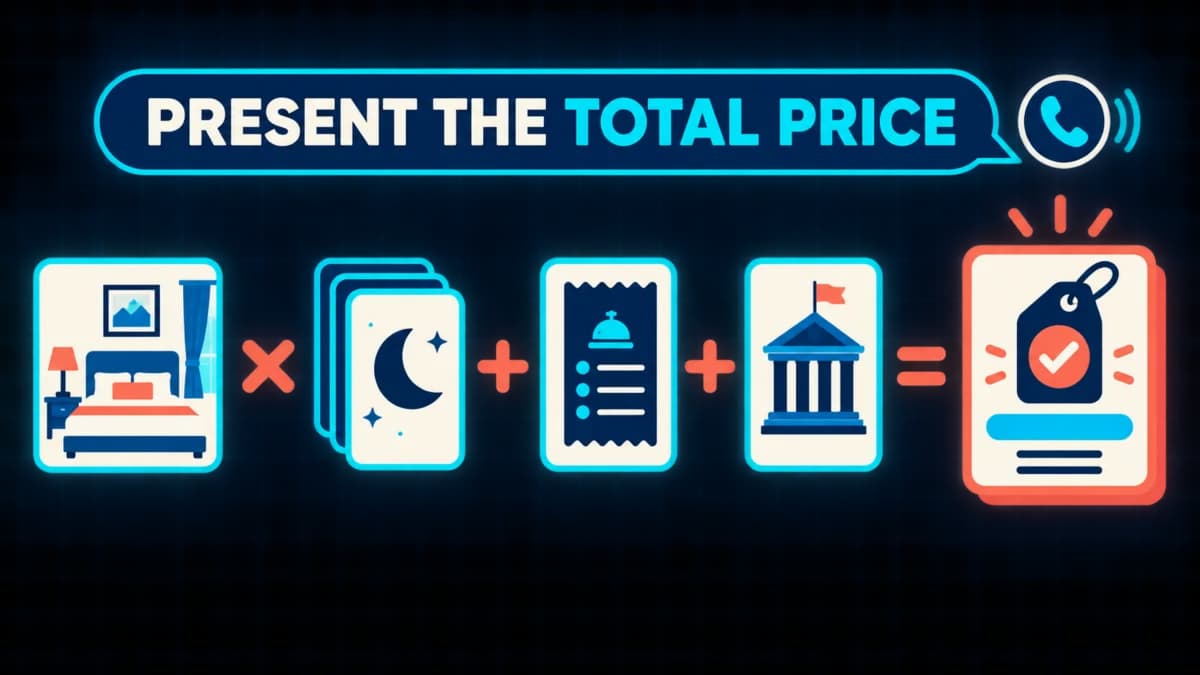
Stay total = Nightly-rate subtotal + Mandatory fees + Applicable taxes
Define every component aloud. State whether the nightly rate changes across the stay, whether meals or add-ons are included, which charges are mandatory, what tax is included or excluded, the deposit or payment timing, and the cancellation or modification terms. A caller should not need mental arithmetic to discover the amount being discussed.
In the United States, the FTC’s Rule on Unfair or Deceptive Fees has applied since 12 May 2025 to businesses offering short-term lodging. When price is stated, the known and calculable total including mandatory charges must be disclosed upfront and displayed more prominently than other pricing information; certain taxes, government charges and optional items may be disclosed later before payment. See the FTC small-entity compliance guide.
For UK-facing offers, January 2026 CMA guidance says the total price should normally include unavoidable charges and, when a component cannot reasonably be calculated, the customer must receive prominent information needed to calculate it. See the CMA price-transparency summary. Requirements vary by jurisdiction and transaction; train agents on the rules that apply to the property and caller rather than copying a foreign script as legal advice.
Hotel OTA objections: responses that stay honest
Caller says | Clarify first | Response pattern |
|---|---|---|
“The OTA is cheaper.” | Is the total for the same dates, occupancy, room type, inclusions and cancellation terms? | Compare like for like. State the verified direct total and differences. Do not claim a price match unless policy permits it. |
“I trust the OTA more.” | Is the concern payment security, confirmation, cancellation support or something else? | Explain the property’s verified booking, confirmation and support process. Never disparage the platform. |
“I get points or a coupon there.” | Is that benefit already applied to the total being compared? | Acknowledge the value. Present only verified direct benefits and let the guest decide. |
“Can you hold the room while I compare?” | What hold period and conditions does property policy allow? | Offer only the documented hold. State the expiry time and that availability may change if no hold is permitted. |
“I need to think.” | What part remains unclear: room fit, total price, policy or timing? | Resolve the unanswered point, then agree a specific follow-up channel and time only with the guest’s consent. |
“Book it now; I’ll read the policy later.” | Has the guest heard and accepted the material terms? | Recap the total, payment and cancellation terms before taking commitment. |
The goal is not to defeat the objection. It is to identify which decision variable is unresolved. If the OTA offer is genuinely better for that guest, an honest comparison protects trust and gives the hotel a concrete reason to review its direct offer.
How to close the reservation without pressure
Choice close: “Would you prefer the Deluxe King or the Courtyard Queen we discussed?”
Confirmation close: “Shall I secure the Deluxe King for 12 to 14 September at the illustrated total and training policy?”
Next-step close: “If you are not ready to book, may I send the verified details and follow up at the time we agree?”
Before payment, recap names, dates, occupancy, room type, inclusions, total price, deposit, payment timing, cancellation terms and any special request that remains a request rather than a guarantee. Ask the caller to confirm the recap. A confirmation number is not enough if the underlying details are wrong.
Payment, recording and guest-data safeguards
Use the property’s approved payment process. Do not copy card details into free-text notes or chat. PCI SSC guidance states that card verification codes—CVC, CVV or CID—must not be stored after authorisation, including for card-on-file or recurring transactions. See the PCI Security Standards Council FAQ.
If calls are recorded, design the process so payment data does not enter recordings or transcripts unless the approved system protects it appropriately. Collect only the contact information required for the reservation and consented follow-up. Verify identity before discussing or changing an existing booking. Property policy and applicable law should define notices, access, retention and deletion.
Turn the script into a coaching scorecard
A script is coachable when each requirement can be observed in the call. Avoid criteria such as “built rapport” unless reviewers know what evidence counts. Better criteria include: confirmed dates and occupancy; asked one priority question; linked the recommendation to a stated need; presented the total and policy; clarified an objection before responding; recapped the booking; recorded the next step.
Start with the 20-criterion Sales Call Scorecard Template and adapt the criteria to reservation calls. If you evaluate a large call population, the AI Call Quality Assurance guide explains how to preserve evidence, route uncertain results to people and calibrate review. The purpose is not to reward agents for reading every line; it is to verify that the guest received accurate, relevant and complete information.
For a weekly coaching review, select one successful close, one unresolved objection and one follow-up call. Compare the evidence against the same stage definitions. Coach one behaviour at a time—for example, moving from listing three rooms to recommending one based on the caller’s priority.
Common script mistakes
Mistake | Why it fails | Better rule |
|---|---|---|
Quoting before confirming dates and occupancy | The rate or room may not match the request | Acknowledge the price question, then verify the minimum pricing inputs |
Listing every available room | The guest must do the matching work | Recommend one primary option and one meaningful alternative |
Saying “best rate” automatically | The claim may be unverified or conditional | State the verified total, inclusions and policy |
Hiding fees until the close | The comparison becomes misleading | Present the complete calculable total and explain exclusions |
Arguing with an OTA comparison | It ignores the caller’s evidence | Compare identical dates, occupancy, room, inclusions and terms |
Treating a special request as guaranteed | Operations may not be able to fulfil it | Label it as a request unless the property has confirmed it |
Following up without consent | It disregards the caller’s preference | Agree the channel, purpose and time before ending the call |
Scoring exact wording | It rewards recital over judgment | Score observable outcomes and evidence |
Frequently asked questions
Should hotel agents read the reservation script word for word?
No. Agents should preserve the required facts, disclosures and confirmation steps while adapting the wording and sequence to what the caller has already said. Score the outcome and evidence, not identical phrasing.
What questions must be asked on every hotel reservation call?
At minimum, confirm stay dates, occupancy, room count and the information needed to quote the correct available option. Before booking, confirm guest details, room and inclusions, total price, payment timing and cancellation terms.
How do you respond when an OTA shows a lower price?
Compare the same dates, occupancy, room type, inclusions, payment timing and cancellation terms. State the verified direct total and differences. Do not promise a match or perk unless the property’s current policy permits it.
How should a hotel quote a nightly rate on the phone?
Give the rate basis and the full stay total. Explain rate changes across nights, inclusions, mandatory charges, applicable taxes, deposit timing and cancellation terms so the caller can make a like-for-like decision.
Can a hotel take card details during a recorded call?
Follow the property’s approved, PCI-compliant payment process. Do not store card verification codes after authorisation, and design recording or pause-and-resume controls so sensitive payment data is not unnecessarily captured.
What is the best closing line for a hotel booking call?
Use an explicit, accurate choice: ask whether the guest wants you to secure the room for the stated dates, total and policy. Then recap the material details and obtain confirmation before processing.
What should a hotel send after the call?
Send the confirmation reference, property identity and contact details, guest names, dates, occupancy, room and inclusions, total and payment status, cancellation or modification terms, and any special requests clearly marked as confirmed or pending.
Use the script as a decision system
A strong reservation call is not the longest call and not the one with the most polished recital. It is the call in which the agent learns what matters, matches the offer to that need, makes the economics and policy understandable, and leaves the guest with an explicit booking or next step.
Want to turn this flow into a reservation-call review rubric? Talk to CallOptix about your current script and QA process. Bring one approved rate example, the current cancellation wording and three anonymised calls so the criteria can be defined from real evidence.
Related Articles


Get the Latest Insights
Get the latest insights on call center optimization and AI-powered sales strategies delivered to your inbox.
By subscribing you agree to receive marketing emails. Unsubscribe anytime.